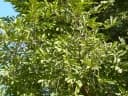
Diospyros mespiliformis
Diospyros mespiliformis
Safety & Hazards
Sawdust of this species, as also of most Diospyros spp., causes dermatitis after continuous contact[1].
Cultivation Details
A plant of the dry to moist tropics, where it is found at elevations up to 1,300 metres. It grows best in areas where annual daytime temperatures are within the range 16 - 27°c, but can tolerate 12 - 34°c[2]. It prefers a mean annual rainfall in the range 500 - 1,300mm, but tolerates 400 - 1,500mm[2]. Prefers a sunny position[2]. Prefers heavy soils[3]. Prefers rocky soils along seasonal water courses and swamps[3]. It grows well in moist, red loams, volcanic and loamy sands[3]. Prefers a pH in the range 5.5 - 6.5, tolerating 5 - 7[2]. Trees can be coppiced[3]. A dioecious species, both male and female forms need to be grown if fruit and seed are required.
Propagation
Seed - pre-soak overnight by immersing the seed in hot water which is allowed to cool in order to break dormancy[3]. They should be sown in flat seed trays filled with river sand. Under ideal conditions seeds germinate within 50 days[3]. Seedlings are then planted out when they reach the 3-leaf stage because if left longer, the taproot may be damaged when transplanting[3]. They are rather slow growing initially but the growth rate speeds up considerably after a year[3]. Young trees do not transplant easily[1] Seed storage behaviour is orthodox. Viability can be maintained for one season in open storage, but can be maintained for several years in hermetic storage at 3°c with 5-6% mc[3]. Root suckers. Cite as: Tropical Plants Database, Ken Fern. tropical.theferns.info. 2026-02-20. <tropical.theferns.info/viewtropical.php?id=Diospyros+mespiliformis>
Pollinators
Bees
References
- [1]The Useful Plants of West Tropical Africa. — Burkil. H. M. · Royal Botanic Gardens; Kew. · 1985 - 2004 ↩︎Brief descriptions and details of the uses of over 4,000 plants. A superb, if terse, resource, it is also available electronically on the Web - see http://www.aluka.org/
- [2]Ecocrop — http://ecocrop.fao.org/ecocrop/srv/en/home ↩︎Basic information on a wide range of useful plants, plus details of environmental needs where available.
- [3]World Agroforesty Centre — http://www.worldagroforestry.org/ ↩︎An excellent online database of a huge range of trees giving very good information on each plant - its uses, ecology, identity, propagation, pests etc.
- [4]Flora Zambesiaca — http://apps.kew.org/efloras/fz/intro.html ↩︎An excellent online flora of plants from the Zambezi River basin. It lists a number of the plant uses as well as the habitats and botanical descriptions of the plants.
- [5]Trees and Shrubs of the Sahel. Their Characteristics and Uses. — von Maydell H. · Deutsche Gesellschaft fur Technische Zusammenarbeit; Germany · 1990 · ISBN 3-8236-1198-4 ↩︎A well-researched book, usually with more than one photograph of each species and good information on the plant and its uses.
- [6]Mansfeld's Database of Agricultural and Horticultural Plants — http://mansfeld.ipk-gatersleben.de/pls/htmldb_pgrc/f?p=185:3:4292127278597336 ↩︎Terse details of a huge range of useful plants.
- [7]Perennial Edible Fruits of the Tropics : an Inventory — Martin, F. W.; Campbell, C. W.; Rubertbe, R. M. · U.S. Dept. of Agriculture, Agricultural Research Service · 1987 ↩︎A booklet giving terse details of almost 300 species of edible fruits, plus regional lists of Botanical and Common names for over 2,500 less well-known edible fruits of the tropics.
- [8]Edible Wild Plants of Tanzania — Ruffo, C.K.: Birnie, A. & Tengnas, B. · Regional Land Management Unit; Nairobi. · 2002 · ISBN 9966-896-60-0 ↩︎A very well presented, simple guide to growing and utilizing wild food plants in Tanzania, with line drawings of each plant, a description, habitat and range, non-food as well as food uses, plus basic information on growing the plants.
- [9]Tropix 7 — CIRAD · http://tropix.cirad.fr/en ↩︎An on-line guide to the timbers of 245 species of trees.
- [10]Dictionary of Economic Plants. — Uphof. J. C. Th. · Weinheim · 1959 · ISBN - ↩︎An excellent and very comprehensive guide but it only gives very short descriptions of the uses without any details of how to utilize the plants. Not for the casual reader.
- [11]Protabase - Plant Resources of Tropical Africa. — http://www.prota.org ↩︎An excellent on-line database with detailed information on over 3,200 species of useful plants of Africa.