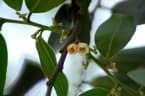
Diospyros malabarica
Diospyros malabarica
Safety & Hazards
None known
Cultivation Details
A plant of the moist, lowland tropics, where it is found at elevations up to 500 metres. It grows best in areas where annual daytime temperatures are within the range 25 - 35°c, but can tolerate 10 - 40°c[1]. It prefers a mean annual rainfall in the range 1,500 - 2,500mm, but tolerates 1,000 - 3,000mm[1]. Fairly tolerant of light levels, able to succeed in fairly dense shade as well as full sun[1]. Succeeds in most soils that are fertile[1]. Succeeds on shallow to deep soil with an alkaline to neutral pH[2]. Prefers a pH in the range 6 - 7, tolerating 5 - 7.5[1]. Productive trees can yield 4,000 fruits per year[3]. We have seen no individual confirmation for this species, but in general Diospyros species are dioecious and require both male and female forms to be grown if fruit and seed are required[4].
Propagation
Seed - it has a very short viability and so should be sown as soon as possible[2]. The flesh should be removed since this contains germination inhibitors[2]. Sow the seed in a shady position in a nursery seedbed. The sowing media for ebony uses soil and fine sand at the ratio 3:1. The seed is planted horizontally or vertically with the radicle end down, with a sowing depth of 1 - 1½ times the thickness of seed. Distance between the seeds is 3 - 5cm. Seeds are very sensitive to desiccation during germination and early growth, so must be regularly watered at this time[2]. Normally the seed will germinate after one week. In one trial, fresh seed, sown one day after collection, showed 85% germination rate within 17 - 65 days[2]. As a rule fresh seeds have a high percentage of fertility. The seedlings develop long taproots at an early stage, often before any appreciable elongation of the shoot takes place. The growth of the seedling is decidedly slow [5]. Cite as: Tropical Plants Database, Ken Fern. tropical.theferns.info. 2026-02-20. <tropical.theferns.info/viewtropical.php?id=Diospyros+malabarica>
Pollinators
Insects
References
- [1]Ecocrop — http://ecocrop.fao.org/ecocrop/srv/en/home ↩︎Basic information on a wide range of useful plants, plus details of environmental needs where available.
- [2]Seed Leaflets — Various · Forest & Landscape. Denmark · http://en.sl.life.ku.dk/Publikationer/Udgivelser/PopulaerPublikationer.aspx?katid={D28373CC-6EF3-4EF8-B097-6D83FABF209E}&serieid={9F1C3DB1-6E7B-4CF1-AF53-F480B0CB40EF}&sort=title ↩︎A series of leaflets, jointly produced by the University of Copenhagen and the Royal Botanic Gardens at Kew, focussing on seed information for a number species, but also giving a lot of other information about each plant.
- [3]A Manual of Indian Timbers. — Gamble. J. S. · Bishen Singh Mahendra Pal Singh · 1972 · ISBN - ↩︎First written in the 19th century, but still a classic, giving a lot of information on the uses and habitats of Indian trees. Not for the casual reader.
- [4]Tree Flora of Sabah and Sarawak Vols 1 - 6 — Soepadmo E.; Saw L.G.; Chung R.C.K. (Editors) · Forest Research Institute Malaysia; Kuala Lumpur. · 2002 · ISBN 983-2181-27-5 ↩︎A flora of the woody plants of Sabah and Sarawak on the island of Borneo, often giving details of plant uses.
- [5]The Silviculture of Indian Trees — Troup. R.S. · Oxford, at the Clarendon Press · 1921 · http://www.biodiversitylibrary.org ↩︎An excellent treatment.
- [6]Medicinal Plants of Asia and the Pacific — Wiart C. · CRC Press, Taylor & Francis Group; Florida. · 2006 · ISBN 0-8493-7245-3 ↩︎An excellent look at a range of plants, in particular focussing on the active principles that could be responsible for the medical activities.
- [7]Mansfeld's Database of Agricultural and Horticultural Plants — http://mansfeld.ipk-gatersleben.de/pls/htmldb_pgrc/f?p=185:3:4292127278597336 ↩︎Terse details of a huge range of useful plants.
- [8]Dictionary of Economic Plants. — Uphof. J. C. Th. · Weinheim · 1959 · ISBN - ↩︎An excellent and very comprehensive guide but it only gives very short descriptions of the uses without any details of how to utilize the plants. Not for the casual reader.
- [9]Commercial Woods of the Philippines; Their Preparation and Uses — Schneider E.E. · Bureau of Forestry; Manilla. · 1916 · http://www.biodiversitylibrary.org ↩︎A series of booklets dealing with various aspects of the Philippine forests. This volume looks at the preparation and uses of the commercial woods of the Philippines. It can be downloaded from the Internet.
- [PFAF]Plants for a Future — pfaf.org ↩︎