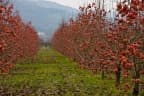
Diospyros kaki
Diospyros kaki
Safety & Hazards
None known
Cultivation Details
Diospyros kaki is a plant of the warm temperate and subtropical zones, it also succeeds at higher elevations up to 2,500 metres in the tropics with the trees fruiting well at lower elevations in some areas[1]. It grows best in areas with a well-distributed rainfall, though it is surprisingly tolerant - able to succeed in semi-arid areas with as little as 300mm of rain, as well as in humid areas with up to 3,000mm of rain[1, 2]. Plants require a seasonal cool period in order to initiate flowering and fruiting[2]. Trees have survived temperatures down to as low as -18°c.[1] The temperature range for growth is reported to be 8 - 35°c, with the optimum between 20 - 31c[1]C. In Brazil, the tree is considered suitable for all zones favourable to Citrus, but those zones with the coldest winters induce the highest yields[1]. Prefers a good deep loamy soil in sun or light shade but succeeds in most soils[3, 4, 5]. Dislikes very acid or wet and poorly drained soils[5]. Prefers a pH in the range 5.5 - 6.5, tolerating 5 - 8.3[6]. The plant requires a sheltered position because the branches are somewhat brittle[5, 1]. Trees produce a long taproot and should be planted out into their permanent positions as soon as possible[5]. The young trees require some winter protection for their first winter or two[PFAF]. There are many named varieties[7]. Some cultivars, such as 'Fuyu', lack the usual astringency and can be eaten whilst still firm, though they develop a richer flavour if allowed to become soft[7, 5]. These non-astringent forms require a warmer climate and do not ripen in cooler areas[7]. The astringent cultivars are somewhat hardier and ripen well in cooler climates than the non-astringent forms[7]. The fruit colours better and is sweeter in warmer areas but in hot conditions has a poor texture and deep black spots develop[7]. If allowed to become very ripe (almost to the point of going rotten), they develop a better flavour than non-astringent forms[7]. Dioecious, but the female tree can produce seedless fruits in the absence of a pollinator. However, unfertilized fruit tends to be smaller and more astringent[5]. This astringency is due to the high content of tannin but once the fruit is fully ripe it loses this astringency and becomes sweet[4]. If fertilized fruit is required, then growing one male for every 8 - 10 females is usually adequate[8].
Propagation
Seed - best sown in a cold frame as soon as it is ripe[9, 5]. Stored seed requires a period of cold-stratification and should be sown as early in the year as possible[10]. It usually germinates in 1 - 6 months at 15°c[11]. Pot up the young seedlings as soon as they are large enough to handle into fairly deep pots and plant them out into their permanent positions in early summer. Give them some protection from winter cold for their first year or two outdoors. Cuttings of half-ripe wood, mid summer in a frame[5]. Layering in spring[5]. Cite as: Temperate Plants Database, Ken Fern. temperate.theferns.info. 2026-02-21. <temperate.theferns.info/plant/Diospyros+kaki>
Pollinators
Data unavailable
References
- [1]World Agroforesty Centre — http://www.worldagroforestry.org/ ↩︎An excellent online database of a huge range of trees giving very good information on each plant - its uses, ecology, identity, propagation, pests etc.
- [2]Perennial Edible Fruits of the Tropics : an Inventory — Martin, F. W.; Campbell, C. W.; Rubertbe, R. M. · U.S. Dept. of Agriculture, Agricultural Research Service · 1987 ↩︎A booklet giving terse details of almost 300 species of edible fruits, plus regional lists of Botanical and Common names for over 2,500 less well-known edible fruits of the tropics.
- [3]Trees and Shrubs Hardy in Great Britain. Vol 1 - 4 and Supplement. — Bean. W. · Murray · 1981 · ISBN - ↩︎A classic with a wealth of information on the plants, but poor on pictures.
- [4]Fruits of the Earth. — Bianchini. F., Corbetta. F. and Pistoia. M. ↩︎Lovely pictures, a very readable book.
- [5]The New RHS Dictionary of Gardening. 1992. — Huxley. A. · MacMillan Press · 1992 · ISBN 0-333-47494-5 ↩︎Excellent and very comprehensive, though it contains a number of silly mistakes. Readable yet also very detailed.
- [6]Ecocrop — http://ecocrop.fao.org/ecocrop/srv/en/home ↩︎Basic information on a wide range of useful plants, plus details of environmental needs where available.
- [7]Cornucopia - A Source Book of Edible Plants. — Facciola. S. · Kampong Publications · 1990 · ISBN 0-9628087-0-9 ↩︎Excellent. Contains a very wide range of conventional and unconventional food plants (including tropical) and where they can be obtained (mainly N. American nurseries but also research institutes and a lot of other nurseries from around the world.
- [8]Encyclopaedia of Herbs and their Uses. — Bown. D. · Dorling Kindersley, London. · 1995 · ISBN 0-7513-020-31 ↩︎A very well presented and informative book on herbs from around the globe. Plenty in it for both the casual reader and the serious student. Just one main quibble is the silly way of having two separate entries for each plant.
- [9]The Reference Manual of Woody Plant Propagation. — Dirr. M. A. and Heuser. M. W. · Athens Ga. Varsity Press · 1987 · ISBN 0942375009 ↩︎A very detailed book on propagating trees. Not for the casual reader.
- [10]Propagation of Trees, Shrubs and Conifers. — Sheat. W. G. · MacMillan and Co · 1948 · ISBN - ↩︎A bit dated but a good book on propagation techniques with specific details for a wide range of plants.
- [11]Focus on Plants. Volume 5. (formerly 'Growing from seed') — Bird. R. (Editor) · Thompson and Morgan. · 1991 · ISBN - ↩︎Very readable magazine with lots of information on propagation. A good article on Corydalis spp.
- [12]Flora of China — Missouri Botanical Garden Press; St. Louis. · 1994 · http://flora.huh.harvard.edu/china/ ↩︎An excellent, comprehensive resource in 25 volumes. In addition to the botanical information the flora also gives basic information on habitat and some uses. An on-line version is also available.
- [13]Plant Resources of Southeast Asia — http://proseanet.org/ ↩︎Lots of information on the uses of the plants of SE Asia.
- [14]IUCN Red List of Threatened Species — http://www.iucnredlist.org/ ↩︎A list of plants under threat and facing possible extinction, usually with brief details of the threats and information on habitat.
- [15]Flora of the USSR. — Komarov. V. L. · Israel Program for Scientific Translation · 1968 · http://www.biodiversitylibrary.org · ISBN - ↩︎An immense (25 or more large volumes) and not yet completed translation of the Russian flora. Full of information on plant uses and habitats but heavy going for casual readers. It can be downloaded from the Internet.
- [16]RHS Dictionary of Plants plus Supplement. 1956 — F. Chittendon. · Oxford University Press · 1951 · ISBN - ↩︎Comprehensive listing of species and how to grow them. Somewhat outdated, it has been replaced in 1992 by a new dictionary (see [ 200 ]).
- [17]Sturtevant's Edible Plants of the World. — Hedrick. U. P. · Dover Publications · 1972 · ISBN 0-486-20459-6 ↩︎Lots of entries, quite a lot of information in most entries and references.
- [18]Growing Unusual Fruit. — Simmons. A. E. · David & Charles; Newton Abbot. · 1972 · ISBN 0-7153-5531-7 ↩︎A very readable book with information on about 100 species that can be grown in Britain (some in greenhouses) and details on how to grow and use them.
- [19]Encyclopaedia of Medicinal Plants. — Chiej. R. · MacDonald · 1984 · ISBN 0-356-10541-5 ↩︎Covers plants growing in Europe. Also gives other interesting information on the plants. Good photographs.
- [20]Dictionary of Economic Plants. — Uphof. J. C. Th. · Weinheim · 1959 · ISBN - ↩︎An excellent and very comprehensive guide but it only gives very short descriptions of the uses without any details of how to utilize the plants. Not for the casual reader.
- [21]A Dictionary of Plants Used by Man. — Usher. G. · Constable · 1974 · ISBN 0094579202 ↩︎Forget the sexist title, this is one of the best books on the subject. Lists a very extensive range of useful plants from around the world with very brief details of the uses. Not for the casual reader.
- [22]Medicinal Plants of China — Duke. J. A. and Ayensu. E. S. · Reference Publications, Inc. · 1985 · ISBN 0-917256-20-4 ↩︎Details of over 1,200 medicinal plants of China and brief details of their uses. Often includes an analysis, or at least a list of constituents. Heavy going if you are not into the subject.
- [23]Glossary of Indian Medicinal Plants (Including the Supplement). — Chopra. R. N., Nayar. S. L. and Chopra. I. C. · Council of Scientific and Industrial Research, New Delhi. · 1986 · ISBN - ↩︎Very terse details of medicinal uses of plants with a wide range of references and details of research into the plants chemistry. Not for the casual reader.
- [24]Oriental Herbs and Vegetables, Vol 39 No. 2. — Brooklyn Botanic Garden · Brooklyn Botanic Garden · 1986 · ISBN - ↩︎A small booklet packed with information.
- [25]Handbook of Chinese Herbs and Formulas. — Yeung. Him-Che. · Institute of Chinese Medicine, Los Angeles · 1985 · ISBN - ↩︎An excellent Chinese herbal giving information on over 500 species. Rather technical and probably best suited to the more accomplished user of herbs.
- [26]Chinese Materia Medica. — Stuart. Rev. G. A. · Taipei. Southern Materials Centre · 1911 · ISBN - ↩︎A translation of an ancient Chinese herbal. Fascinating.
- [27]Chinese Economic Trees — Woon Young Chun · Commercial Press; Shanghai. · 1921 · http://www.biodiversitylibrary.org ↩︎Brief details of many of the Chinese trees with economic importance. It can be downloaded from the Internet.
- [28]Commercial Woods of the Philippines; Their Preparation and Uses — Schneider E.E. · Bureau of Forestry; Manilla. · 1916 · http://www.biodiversitylibrary.org ↩︎A series of booklets dealing with various aspects of the Philippine forests. This volume looks at the preparation and uses of the commercial woods of the Philippines. It can be downloaded from the Internet.
- [PFAF]Plants for a Future — pfaf.org ↩︎