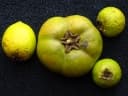
Diospyros digyna
Diospyros digyna
Safety & Hazards
The unripe fruit is used as a fish poison[1].
Cultivation Details
A plant of the moist tropics and subtropics. It can be grown at elevations up to 2,000 metres, but does best below 600 metres[2]. It grows best in areas where annual daytime temperatures are within the range 20 - 27°c, but can tolerate 12 - 34°c[1]. Mature plants can be killed by temperatures of -2°c or lower, whilst young growth will be severely damaged at 0°c[1]. It prefers a mean annual rainfall in the range 1,200 - 1,600mm, but tolerates 1,000 - 2,400mm[1]. Prefers a sunny position, tolerating some shade[1]. The tree adapts to different soil types and survives flooding, but it is rather sensitive to drought, requiring abundant irrigation in dry areas[2]. Plants are well adapted to calcareous soils[3]. Prefers a pH in the range 6 - 7, tolerating 5.5 - 7.5[1]. A dioecious species, both male and female forms need to be grown if fruit and seed are required[4]. Although dioecious, solitary planted female plants have been observed to produce seedless fruits in the abseb=nce of a male, and on rare occasions have produced fruit with fertile seeds[4]. Seedling trees commence bearing fruit when 5 - 6 years old, whilst grafted specimens can fruit when 2 - 3 years old[3]. Flowers are borne on the new shoots; hence the crop cycle is linked to flushing[2]. Some trees bear flowers that are self-incompatible, so it is not advisable to plant a solitary tree[2]. Fruit on cultivated trees is often seedless or nearly so[2]. Black persimmon is said to have 4 times the vitamin C content of sweet, and to be a good source of calcium and phosphorus. Response to the taste varies greatly between people, and the dark chocolate colour of the pulp is considered to be unattractive. Nevertheless, because the tree is robust, well-adapted to the tropics, and heavy-bearing, a close re-examination of its potential is merited[2]. There are some named varieties[5]. We have seen no individual confirmation for this species, but in general Diospyros species are dioecious and require both male and female forms to be grown if fruit and seed are required[4].
Propagation
Seed - commonly propagated from seed, which remains viable for several months if stored dry[2]. Seeds germinate in about 30 days[2]. As a rule fresh seeds have a high percentage of fertility. The seedlings develop long taproots at an early stage, often before any appreciable elongation of the shoot takes place. The growth of the seedling is decidedly slow [6]. Budding or grafting on seedling rootstocks is the way to propagate seedless types[2]. Cite as: Tropical Plants Database, Ken Fern. tropical.theferns.info. 2026-02-20. <tropical.theferns.info/viewtropical.php?id=Diospyros+digyna>
Pollinators
Data unavailable
References
- [1]Ecocrop — http://ecocrop.fao.org/ecocrop/srv/en/home ↩︎Basic information on a wide range of useful plants, plus details of environmental needs where available.
- [2]World Agroforesty Centre — http://www.worldagroforestry.org/ ↩︎An excellent online database of a huge range of trees giving very good information on each plant - its uses, ecology, identity, propagation, pests etc.
- [3]Perennial Edible Fruits of the Tropics : an Inventory — Martin, F. W.; Campbell, C. W.; Rubertbe, R. M. · U.S. Dept. of Agriculture, Agricultural Research Service · 1987 ↩︎A booklet giving terse details of almost 300 species of edible fruits, plus regional lists of Botanical and Common names for over 2,500 less well-known edible fruits of the tropics.
- [4]Tree Flora of Sabah and Sarawak Vols 1 - 6 — Soepadmo E.; Saw L.G.; Chung R.C.K. (Editors) · Forest Research Institute Malaysia; Kuala Lumpur. · 2002 · ISBN 983-2181-27-5 ↩︎A flora of the woody plants of Sabah and Sarawak on the island of Borneo, often giving details of plant uses.
- [5]Cornucopia II — Facciola. S. · Kampong Publications, California. · 1998 · ISBN 0-9628087-2-5 ↩︎The second edition of an excellent guide to the edible uses of plants, though it does not give any details of cultivation etc.
- [6]The Silviculture of Indian Trees — Troup. R.S. · Oxford, at the Clarendon Press · 1921 · http://www.biodiversitylibrary.org ↩︎An excellent treatment.
- [7]Flora of Guatemala — Standley P.C. & J. A. Steyermark · 1946 - 1976 · http://www.archive.org/ ↩︎A superb reference, though somewhat dated. Gives lots of plant uses as well as information on plant habit and habitat. The entire flora (13 volumes) can now be downloaded from http://www.archive.org/
- [8]Brazilian Fruits and Cultivated Exotics — Lorenzi. H.; Bacher. L.; Lacerda. M.; Sartori. S. · Instituto Plantarum De Estudos Da Flora LTDA; Brazil. · 2000 · ISBN 85-867174-24-0 ↩︎A superb book, giving information on several hundred fruit species. Each entry has a brief description of the plant and its uses, accompanied by one to many excellent quality photographs of the fruits.
- [9]Tropical Food Gardens — Norrington. L. · Bloomings Books (Melbourne) · 2001 · ISBN 1-876473-41-x ↩︎Excellent little book giving some basic information on a range of plants.