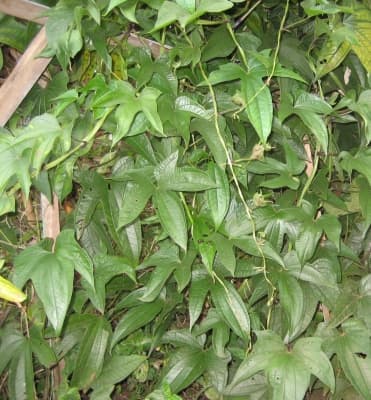
Dioscorea trifida
Dioscorea trifida
Safety & Hazards
None known
Cultivation Details
A plant of the moist tropics and subtropics. It grows best in areas where annual daytime temperatures are within the range 18 - 26°c, but can tolerate 10 - 36°c[1]. It can be killed by temperatures of 7°c or lower[1]. It prefers a mean annual rainfall in the range 1,200 - 2,600mm, but tolerates 1,000 - 4,000mm[1]. This species grows better at lower temperatures than most tropical yams[2]. Prefers a sunny position, tolerating some shade[1]. For best yields, most yams require a deep, well-drained, sandy loam that is not liable to water-logging[2]. This species will succeed in a wide range of soils so long as there is plenty of organic matter and they are well drained[2]. Prefers a pH in the range 6 - 6.7, tolerating 5.3 - 8[1]. Daylengths of more than 12 hours are preferred during the early growing season since this encourages vegetative growth; daylengths of less than 12 hours towards the end of the growing season will encourage tuber formation and development[2]. Crops can be obtained in 9 - 11 months from planting, yields of 15 - 20 tonnes per hectare have been achieved[2]. Plants produce groups of 5 - 50 tubers from enlarged stolons or runners[2]. This is perhaps the only cultivated yam species that has retained its full reproductive potential through seed formation[2]. There are some named varieties[3, 2]. A dioecious species, both male and female plants need to be grown if seed is required.
Propagation
Seed - sown in containers and planted out at the beginning of the growing season[2]. Cuttings of tubers. Small tubers can be cut into 2 - 4 sections, larger ones into 6 - 8 sections. Each section should have 2 - 3 dormant buds. The cut tuber is often left in the sun for several hours to promote wound healing and reduce the risk of fungal infection[2]. Cite as: Tropical Plants Database, Ken Fern. tropical.theferns.info. 2026-02-20. <tropical.theferns.info/viewtropical.php?id=Dioscorea+trifida>
Pollinators
Data unavailable
References
- [1]Ecocrop — http://ecocrop.fao.org/ecocrop/srv/en/home ↩︎Basic information on a wide range of useful plants, plus details of environmental needs where available.
- [2]Vegetables in the Tropics — Tindall. H. D. · MacMillan, Oxford. · 1983 · ISBN 0-333-24268-8 ↩︎An excellent, in-depth look at the main vegetable crops that can be grown in the Tropics, plus many less well-known plants.
- [3]Dictionary of Economic Plants. — Uphof. J. C. Th. · Weinheim · 1959 · ISBN - ↩︎An excellent and very comprehensive guide but it only gives very short descriptions of the uses without any details of how to utilize the plants. Not for the casual reader.
- [4]Cornucopia II — Facciola. S. · Kampong Publications, California. · 1998 · ISBN 0-9628087-2-5 ↩︎The second edition of an excellent guide to the edible uses of plants, though it does not give any details of cultivation etc.