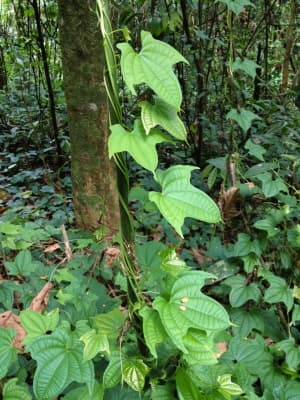
Dioscorea sansibarensis
Dioscorea sansibarensis
Safety & Hazards
All parts of the plant, especially the wild form, are poisonous[1]. The tuber has been used as an ordeal-poison, whilst both the tuber, and the bulbil, are used for poisoning wild animals such as pigs that can cause damage to crops[1]. They are also used as a fish-poison[1]. The tuber contains dioscorine, dihydrodioscorine and other unnamed alkaloids[1].
Cultivation Details
Some selection to reduce toxicity has been practised, to the extent at least that in some races toxicity is confined to the upper part of the tuber[1]. The leaves contain glands filled with a fluid holding nitrifying bacteria[1]. Bulbils are produced at the leaf-axils, dark purplish brown and usually larger than those of D. bulbifera[1]. The bulbils are adapted for water dispersal - at first they sink in water, then float and on being left by receding water will germinate[1]. They are toxic and inedible[1].
Propagation
Seed - Cite as: Tropical Plants Database, Ken Fern. tropical.theferns.info. 2026-02-20. <tropical.theferns.info/viewtropical.php?id=Dioscorea+sansibarensis>
Pollinators
Data unavailable
References
- [1]The Useful Plants of West Tropical Africa. — Burkil. H. M. · Royal Botanic Gardens; Kew. · 1985 - 2004 ↩︎Brief descriptions and details of the uses of over 4,000 plants. A superb, if terse, resource, it is also available electronically on the Web - see http://www.aluka.org/
- [2]Ecocrop — http://ecocrop.fao.org/ecocrop/srv/en/home ↩︎Basic information on a wide range of useful plants, plus details of environmental needs where available.
- [3]Edible Wild Plants of Tanzania — Ruffo, C.K.: Birnie, A. & Tengnas, B. · Regional Land Management Unit; Nairobi. · 2002 · ISBN 9966-896-60-0 ↩︎A very well presented, simple guide to growing and utilizing wild food plants in Tanzania, with line drawings of each plant, a description, habitat and range, non-food as well as food uses, plus basic information on growing the plants.