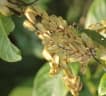
Dioscorea pentaphylla
Dioscorea pentaphylla
Safety & Hazards
Edible species of Dioscorea have opposite leaves whilst poisonous species have alternate leaves[1].
Cultivation Details
Plants grow best in lowland tropical areas with a temperature around 26 - 34°c; a well-defined dry season of 2 - 5 months; and a total rainfall of 1,300 - 1,700mm evenly distributed throughout the remainder of the year[2]. For best yields, this species requires a deep, well-drained, sandy loam that is not liable to water-logging[2]. Daylengths of more than 12 hours are preferred during the early growing season since this encourages vegetative growth; daylengths of less than 12 hours towards the end of the growing season will encourage tuber formation and development[2]. There are some named varieties[2]. An extremely widespread and variable species, with at least 16 varieties being recognised[3]. A dioecious species, both male and female plants need to be grown if seed is required.
Propagation
Seed - not normally used to propagate this species. Cuttings of tubers. Small tubers can be cut into 2 - 4 sections, larger ones into 6 - 8 sections. Each section should have 2 - 3 dormant buds. The cut tuber is often left in the sun for several hours to promote wound healing and reduce the risk of fungal infection[2]. Cite as: Tropical Plants Database, Ken Fern. tropical.theferns.info. 2026-02-20. <tropical.theferns.info/viewtropical.php?id=Dioscorea+pentaphylla>
Pollinators
Data unavailable
References
- [1]Atlas of Medicinal Plants. — Kariyone. T. · Nihon Rinshosha; Osaka · 1973 ↩︎A good Japanese herbal.
- [2]Vegetables in the Tropics — Tindall. H. D. · MacMillan, Oxford. · 1983 · ISBN 0-333-24268-8 ↩︎An excellent, in-depth look at the main vegetable crops that can be grown in the Tropics, plus many less well-known plants.
- [3]Flora of China — Missouri Botanical Garden Press; St. Louis. · 1994 · http://flora.huh.harvard.edu/china/ ↩︎An excellent, comprehensive resource in 25 volumes. In addition to the botanical information the flora also gives basic information on habitat and some uses. An on-line version is also available.
- [4]Ecocrop — http://ecocrop.fao.org/ecocrop/srv/en/home ↩︎Basic information on a wide range of useful plants, plus details of environmental needs where available.
- [5]Mansfeld's Database of Agricultural and Horticultural Plants — http://mansfeld.ipk-gatersleben.de/pls/htmldb_pgrc/f?p=185:3:4292127278597336 ↩︎Terse details of a huge range of useful plants.
- [6]Cornucopia II — Facciola. S. · Kampong Publications, California. · 1998 · ISBN 0-9628087-2-5 ↩︎The second edition of an excellent guide to the edible uses of plants, though it does not give any details of cultivation etc.
- [7]Plants and People of Nepal — Manandhar. N. P. · Timber Press. Oregon. · 2002 · ISBN 0-88192-527-6 ↩︎Excellent book, covering over 1,500 species of useful plants from Nepal together with information on the geography and peoples of Nepal. Good descriptions of the plants with terse notes on their uses.