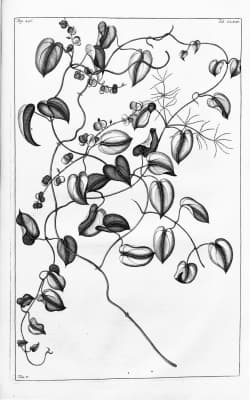
Dioscorea nummularia
Dioscorea nummularia
Safety & Hazards
Edible species of Dioscorea have opposite leaves whilst poisonous species have alternate leaves[1].
Cultivation Details
Plants grow best in lowland tropical areas with a temperature around 26 - 34°c; a well-defined dry season of 2 - 5 months; and a total rainfall of 1,300 - 1,700mm evenly distributed throughout the remainder of the year[2]. For best yields, this species requires a deep, well-drained, sandy loam that is not liable to water-logging[2]. Daylengths of more than 12 hours are preferred during the early growing season since this encourages vegetative growth; daylengths of less than 12 hours towards the end of the growing season will encourage tuber formation and development[2]. There are some named varieties[2]. The tubers form at an appreciable depth and are often left for 2 - 3 years to mature before harvesting[2]. A dioecious species, both male and female plants need to be grown if seed is required.
Propagation
Seed - not normally used to propagate this species. Cuttings of tubers. Small tubers can be cut into 2 - 4 sections, larger ones into 6 - 8 sections. Each section should have 2 - 3 dormant buds. The cut tuber is often left in the sun for several hours to promote wound healing and reduce the risk of fungal infection[2]. Cite as: Tropical Plants Database, Ken Fern. tropical.theferns.info. 2026-02-20. <tropical.theferns.info/viewtropical.php?id=Dioscorea+nummularia>
Pollinators
Data unavailable
References
- [1]Atlas of Medicinal Plants. — Kariyone. T. · Nihon Rinshosha; Osaka · 1973 ↩︎A good Japanese herbal.
- [2]Vegetables in the Tropics — Tindall. H. D. · MacMillan, Oxford. · 1983 · ISBN 0-333-24268-8 ↩︎An excellent, in-depth look at the main vegetable crops that can be grown in the Tropics, plus many less well-known plants.
- [3]Ecocrop — http://ecocrop.fao.org/ecocrop/srv/en/home ↩︎Basic information on a wide range of useful plants, plus details of environmental needs where available.
- [4]Mansfeld's Database of Agricultural and Horticultural Plants — http://mansfeld.ipk-gatersleben.de/pls/htmldb_pgrc/f?p=185:3:4292127278597336 ↩︎Terse details of a huge range of useful plants.