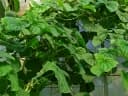
Dioscorea esculenta
Dioscorea esculenta
Safety & Hazards
Edible species of Dioscorea have opposite leaves whilst poisonous species have alternate leaves[1].
Cultivation Details
A plant of the drier to wet tropical lowlands, where it is found at elevations up to 900 metres. It grows best in areas where annual daytime temperatures are within the range 28 - 32°c, but can tolerate 17 - 45°c[2]. It can be killed by temperatures of 9°c or lower[2]. It prefers a mean annual rainfall in the range 800 - 2,000mm, but tolerates 600 - 8,000mm[2]. Plants like a well-defined dry season of 2 - 5 months[2]. This species will grow in drier climates than other yams, so long as the rainfall is evenly distributed through the year[3]. Succeeds in full sun and also in light shade[2]. For best yields, this species requires a deep, well-drained, sandy loam that is not liable to water-logging[3]. This species will succeed in poor gravelly soils, especially if enriched with organic matter[3]. Prefers a pH in the range 5.5 - 6.5, tolerating 4.5 - 8.5[2]. Daylengths of more than 12 hours are preferred during the early growing season since this encourages vegetative growth; daylengths of less than 12 hours towards the end of the growing season will encourage tuber formation and development[3]. Crops take 7 - 10 months to mature, yields of 7 - 20 tonnes per hectare have been achieved[3]. There are some named varieties[3, 4]. Two main forms of this plant are sometimes recognised:- Var fasciculata (Roxb.)Prain. & Burk. Arose in cultivation and has no spines. Var spinosa (Roxb.)Prain. & Burk. Is believed by many botanists to be the wild form. It has thorny roots protecting the crown of the rootstock[5, 3]. This is a variable characteristic, however[3]. The plant rarely produces flowers[2]. A dioecious species, both male and female plants need to be grown if seed is required.
Propagation
Seed - not normally used to propagate this species. Cuttings of tubers. Pieces of tuber, each weighing around 50 - 80g with dormant buds, are planted in situ 4 - 8cm deep with the stem pointing downwards[3]. The cut tuber is often first left in the sun for several hours to promote wound healing and reduce the risk of fungal infection[3]. Cite as: Tropical Plants Database, Ken Fern. tropical.theferns.info. 2026-02-20. <tropical.theferns.info/viewtropical.php?id=Dioscorea+esculenta>
Pollinators
Data unavailable
References
- [1]Atlas of Medicinal Plants. — Kariyone. T. · Nihon Rinshosha; Osaka · 1973 ↩︎A good Japanese herbal.
- [2]Ecocrop — http://ecocrop.fao.org/ecocrop/srv/en/home ↩︎Basic information on a wide range of useful plants, plus details of environmental needs where available.
- [3]Vegetables in the Tropics — Tindall. H. D. · MacMillan, Oxford. · 1983 · ISBN 0-333-24268-8 ↩︎An excellent, in-depth look at the main vegetable crops that can be grown in the Tropics, plus many less well-known plants.
- [4]Cornucopia II — Facciola. S. · Kampong Publications, California. · 1998 · ISBN 0-9628087-2-5 ↩︎The second edition of an excellent guide to the edible uses of plants, though it does not give any details of cultivation etc.
- [5]Flora of China — Missouri Botanical Garden Press; St. Louis. · 1994 · http://flora.huh.harvard.edu/china/ ↩︎An excellent, comprehensive resource in 25 volumes. In addition to the botanical information the flora also gives basic information on habitat and some uses. An on-line version is also available.