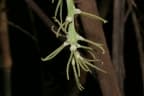
Dioscorea dumetorum
Dioscorea dumetorum
Safety & Hazards
Edible species of Dioscorea have opposite leaves whilst poisonous species have alternate leaves[1]. The roots of this species contain toxic substances, including the alkaloid dihydrodioscorine[2]. This can be destroyed by thorough cooking[2]. Cultivated forms of the plant contain much less alkaloids than wild plants[2]. The physiological effect of the poisonous tubers is to paralyse the respiratory system[3].
Cultivation Details
A plant of the moist tropics, where it is found at elevations up to 1,500 metres. It grows best in areas where annual daytime temperatures are within the range 25 - 32°c, but can tolerate 15 - 40°c[4]. It can be killed by temperatures of 9°c or lower[4]. It prefers a mean annual rainfall in the range 1,000 - 1,700mm, but tolerates 700 - 4,200mm[4]. It likes a well-defined dry season of 2 - 5 months[2]. Prefers a sunny position, also succeeding in light shade[4]. For best yields, this species requires a deep, well-drained, sandy loam that is not liable to water-logging[2]. Prefers a pH in the range 5.5 - 6.5, tolerating 4.8 - 8.5[4]. Daylengths of more than 12 hours are preferred during the early growing season since this encourages vegetative growth; daylengths of less than 12 hours towards the end of the growing season will encourage tuber formation and development[2]. Plants take 8 - 10 months to mature a crop, yields are considered to be higher than most other cultivated African yams[2]. There are some named varieties[5, 2]. Genetic variation there certainly is: the plant has undergone a degree of ennoblement by man's selection so that there is recognized a number of edible cultivars. In Nigeria there are yellow, white and pale yellow forms. In N Nigeria two races, one poisonous, one not, can be distinguished by hairiness, the poisonous one being the more tomentose. Cultivars are numerous in Dahomey[3]. There appears to be some variation in toxicity perhaps due to edaphic, phenologic or other cryptic factors. Material from the Congo has been reported free of active principles[3]. A dioecious species, both male and female plants need to be grown if seed is required.
Propagation
Seed - not normally used to propagate this species. Cuttings of tubers. Small tubers can be cut into 2 - 4 sections, larger ones into 6 - 8 sections. Each section should have 2 - 3 dormant buds. The cut tuber is often left in the sun for several hours to promote wound healing and reduce the risk of fungal infection[2]. Cite as: Tropical Plants Database, Ken Fern. tropical.theferns.info. 2026-02-20. <tropical.theferns.info/viewtropical.php?id=Dioscorea+dumetorum>
Pollinators
Data unavailable
References
- [1]Atlas of Medicinal Plants. — Kariyone. T. · Nihon Rinshosha; Osaka · 1973 ↩︎A good Japanese herbal.
- [2]Vegetables in the Tropics — Tindall. H. D. · MacMillan, Oxford. · 1983 · ISBN 0-333-24268-8 ↩︎An excellent, in-depth look at the main vegetable crops that can be grown in the Tropics, plus many less well-known plants.
- [3]The Useful Plants of West Tropical Africa. — Burkil. H. M. · Royal Botanic Gardens; Kew. · 1985 - 2004 ↩︎Brief descriptions and details of the uses of over 4,000 plants. A superb, if terse, resource, it is also available electronically on the Web - see http://www.aluka.org/
- [4]Ecocrop — http://ecocrop.fao.org/ecocrop/srv/en/home ↩︎Basic information on a wide range of useful plants, plus details of environmental needs where available.
- [5]Dictionary of Economic Plants. — Uphof. J. C. Th. · Weinheim · 1959 · ISBN - ↩︎An excellent and very comprehensive guide but it only gives very short descriptions of the uses without any details of how to utilize the plants. Not for the casual reader.
- [6]Edible Wild Plants of Tanzania — Ruffo, C.K.: Birnie, A. & Tengnas, B. · Regional Land Management Unit; Nairobi. · 2002 · ISBN 9966-896-60-0 ↩︎A very well presented, simple guide to growing and utilizing wild food plants in Tanzania, with line drawings of each plant, a description, habitat and range, non-food as well as food uses, plus basic information on growing the plants.