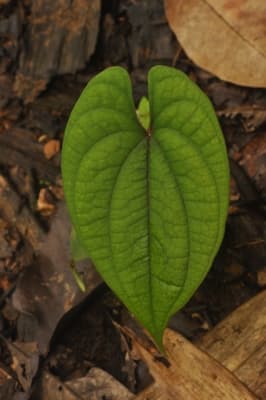
Dioscorea deltoidea
Dioscorea deltoidea
Safety & Hazards
Edible species of Dioscorea have opposite leaves whilst poisonous species have alternate leaves[1].
Cultivation Details
Easily grown in a fertile well-drained soil in a sunny position or light shade[2]. Prefers a rich light soil[3]. Plants produce tubercles (small tubers that are formed in the leaf axils of the stems), and can be propagated by this means[PFAF]. A climbing plant that supports itself by twining around the branches of other plants[4]. Dioecious. Both male and female forms must be grown if seed is required.
Propagation
Seed - sow early spring to mid spring in a sunny position in a warm greenhouse and only just cover. It germinates in 1 - 3 weeks at 20°c[5]. Prick out the seedlings as soon as they are large enough to handle and grow on in a greenhouse for their first year. Plant out in late spring as the plant comes into new growth. Basal stem cuttings in the summer[6]. Division in the dormant season, never when in growth[3]. The plant will often produce a number of shoots, the top 5 - 10 cm of the root below each shoot can be potted up to form a new plant whilst the lower part of the root can possibly be eaten[PFAF]. Tubercles (baby tubers) are formed in the leaf axils. These are harvested in late summer and early autumn when about the size of a pea and coming away easily from the plant. They should be potted up immediately in individual pots in a greenhouse or cold frame. Plant out in early summer when in active growth[PFAF]. Cite as: Temperate Plants Database, Ken Fern. temperate.theferns.info. 2026-02-21. <temperate.theferns.info/plant/Dioscorea+deltoidea>
Pollinators
Data unavailable
References
- [1]Atlas of Medicinal Plants. — Kariyone. T. · Nihon Rinshosha; Osaka · 1973 ↩︎A good Japanese herbal.
- [2]The New RHS Dictionary of Gardening. 1992. — Huxley. A. · MacMillan Press · 1992 · ISBN 0-333-47494-5 ↩︎Excellent and very comprehensive, though it contains a number of silly mistakes. Readable yet also very detailed.
- [3]RHS Dictionary of Plants plus Supplement. 1956 — F. Chittendon. · Oxford University Press · 1951 · ISBN - ↩︎Comprehensive listing of species and how to grow them. Somewhat outdated, it has been replaced in 1992 by a new dictionary (see [ 200 ]).
- [4]Gardening on Walls — Grey-Wilson. C. & Matthews. V. · Collins · 1983 · ISBN 0-00-219220-0 ↩︎A nice little book about plants for growing against walls and a small section on plants that can grow in walls.
- [5]Focus on Plants. Volume 5. (formerly 'Growing from seed') — Bird. R. (Editor) · Thompson and Morgan. · 1991 · ISBN - ↩︎Very readable magazine with lots of information on propagation. A good article on Corydalis spp.
- [6]The Gardener's Assistant. — Thompson. B. · Blackie and Son. · 1878 · ISBN - ↩︎Excellent general but extensive guide to gardening practices in the 19th century. A very good section on fruits and vegetables with many little known species.
- [7]Flora of China — Missouri Botanical Garden Press; St. Louis. · 1994 · http://flora.huh.harvard.edu/china/ ↩︎An excellent, comprehensive resource in 25 volumes. In addition to the botanical information the flora also gives basic information on habitat and some uses. An on-line version is also available.
- [8]Plant Resources of Southeast Asia — http://proseanet.org/ ↩︎Lots of information on the uses of the plants of SE Asia.
- [9]Forest Flora of Srinagar. — Singh. Dr. G. and Kachroo. Prof. Dr. P. · Bishen Singh Mahendra Pal Singh · 1976 · ISBN - ↩︎A good flora of the western Himalayas but poorly illustrated. Some information on plant uses.
- [10]Sturtevant's Edible Plants of the World. — Hedrick. U. P. · Dover Publications · 1972 · ISBN 0-486-20459-6 ↩︎Lots of entries, quite a lot of information in most entries and references.
- [11]Plants for Human Consumption. — Kunkel. G. · Koeltz Scientific Books · 1984 · ISBN 3874292169 ↩︎An excellent book for the dedicated. A comprehensive listing of Latin names with a brief list of edible parts.
- [12]Plants and People of Nepal — Manandhar. N. P. · Timber Press. Oregon. · 2002 · ISBN 0-88192-527-6 ↩︎Excellent book, covering over 1,500 species of useful plants from Nepal together with information on the geography and peoples of Nepal. Good descriptions of the plants with terse notes on their uses.
- [13]A Field Guide to Medicinal Plants. Eastern and Central N. America. — Foster. S. & Duke. J. A. · Houghton Mifflin Co. · 1990 · ISBN 0395467225 ↩︎A concise book dealing with almost 500 species. A line drawing of each plant is included plus colour photographs of about 100 species. Very good as a field guide, it only gives brief details about the plants medicinal properties.
- [14]Glossary of Indian Medicinal Plants (Including the Supplement). — Chopra. R. N., Nayar. S. L. and Chopra. I. C. · Council of Scientific and Industrial Research, New Delhi. · 1986 · ISBN - ↩︎Very terse details of medicinal uses of plants with a wide range of references and details of research into the plants chemistry. Not for the casual reader.
- [15]Flora of Pakistan — http://www.efloras.org ↩︎As of 2006, there is not much information on habitats available, but it is being developed and promises to be an excellent resource.
- [PFAF]Plants for a Future — pfaf.org ↩︎