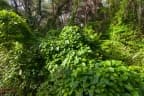
Dioscorea bulbifera
Dioscorea bulbifera
Safety & Hazards
Edible species of Dioscorea have opposite leaves whilst poisonous species have alternate leaves[1]. The aerial bulbs of this species contain toxic substances, including the alkaloid dioscorine[2]. This can be destroyed by thorough cooking[2]. Asiatic forms of the plant usually contain less alkaloids than plants originating in Africa[2]. There are forms that are almost or entirely free of toxins[3].
Cultivation Details
A plant of the moist, lowland tropics. It grows best in areas where annual daytime temperatures are within the range 20 - 30°c, but can tolerate 12 - 38°c[4]. It can be killed by temperatures of 9°c or lower[4]. It prefers a mean annual rainfall in the range 1,200 - 2,600mm, but tolerates 900 - 4,000mm[4]. It prefers a well-defined dry season of 2 - 3 months[4]. This species is more tolerant than most other yams of temperatures below 25°c[2]. For best yields, this species requires a deep, well-drained, sandy loam that is not liable to water-logging[2]. Prefers a pH in the range 6 - 6.7, tolerating 5.3 - 8[4]. Daylengths of more than 12 hours are preferred during the early growing season since this encourages vegetative growth; daylengths of less than 12 hours towards the end of the growing season will encourage tuber formation and development[2]. The bulbils are produced in 5 - 6 months from planting, though some forms can produce a crop in as little as 3 months[2]. Average yields of the bulbs are in the range of 3 - 5 tonnes per hectare, though up to 15 tonnes have been obtained[2]. The bulbils of selected cultivars tend to be angular with a flattened shape and a skin-colour which evokes the name 'turkey liver yam'. They may attain as much as 2 kg in weight but an average weight is about 0.5 kg. Races with increased bulbil production tend to show a reduction of the tuber, and in those with the highest bulbil return the tuber is but a woody rootstock[3]. Bulbils are ready for harvesting when they fall off the plant at a slight touch[3]. When produced, yields of 2 - 8 tonnes per hectare of the roots have been obtained[2]. There are some named varieties[2]. Aerial yam is a species of many races[3]. The wild ones, which are toxic raw, have globose, dark brown to liver-coloured, non-angular bulbils which serve as a famine-food, as do the tubers[3]. Wild strains are often planted intermixed with or on the perimeter of plantings of improved races as a protection against thieving[3]. Cattle eating them accidentally may be fatally poisoned showing frothing at the mouth and bloating[3]. The species is in the process of ennoblement and selected cultivars show in varying degree bitterness and poisonousness. Of some races even after prolonged preparation the bulbils remain bitter. Superior races are said to be very palatable and sweet, and to be entirely free from toxic substances so that consumption, even raw, is safe[3]. The skin is grey, lighter coloured than the wild forms, and the flesh is pale yellow to near white[3]. A dioecious species, both male and female plants need to be grown if seed is required.
Propagation
Seed - rarely produced, they are not normally used to propagate this species. Cuttings of tubers. Small tubers can be cut into 2 - 4 sections, larger ones into 6 - 8 sections. Each section should have 2 - 3 dormant buds. The cut tuber is often left in the sun for several hours to promote wound healing and reduce the risk of fungal infection[2]. Aerial tubers can also be used, they usually produce vigorous plants[2]. The aerial bulbs are often divided into 2 or more equal sized pieces[2]. Plants often need to be grown for two seasons in order to produce full-size aerial bulbs[2]. Cite as: Tropical Plants Database, Ken Fern. tropical.theferns.info. 2026-02-20. <tropical.theferns.info/viewtropical.php?id=Dioscorea+bulbifera>
Pollinators
Data unavailable
References
- [1]Atlas of Medicinal Plants. — Kariyone. T. · Nihon Rinshosha; Osaka · 1973 ↩︎A good Japanese herbal.
- [2]Vegetables in the Tropics — Tindall. H. D. · MacMillan, Oxford. · 1983 · ISBN 0-333-24268-8 ↩︎An excellent, in-depth look at the main vegetable crops that can be grown in the Tropics, plus many less well-known plants.
- [3]The Useful Plants of West Tropical Africa. — Burkil. H. M. · Royal Botanic Gardens; Kew. · 1985 - 2004 ↩︎Brief descriptions and details of the uses of over 4,000 plants. A superb, if terse, resource, it is also available electronically on the Web - see http://www.aluka.org/
- [4]Ecocrop — http://ecocrop.fao.org/ecocrop/srv/en/home ↩︎Basic information on a wide range of useful plants, plus details of environmental needs where available.
- [5]Cornucopia II — Facciola. S. · Kampong Publications, California. · 1998 · ISBN 0-9628087-2-5 ↩︎The second edition of an excellent guide to the edible uses of plants, though it does not give any details of cultivation etc.
- [6]Plants and People of Nepal — Manandhar. N. P. · Timber Press. Oregon. · 2002 · ISBN 0-88192-527-6 ↩︎Excellent book, covering over 1,500 species of useful plants from Nepal together with information on the geography and peoples of Nepal. Good descriptions of the plants with terse notes on their uses.