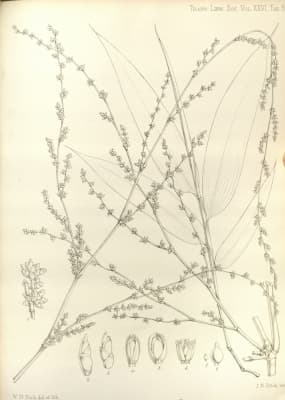
Dinochloa scandens
Dinochloa scandens
Safety & Hazards
None known
Cultivation Details
These bamboos can present a considerable problem, because they become weeds in logged and disturbed forest, preventing regeneration of commercial timber[1]. Bamboos have an interesting method of growth. Each plant produces a number of new stems annually - these stems grow to their maximum height in their first year of growth, subsequent growth in the stem being limited to the production of new side branches and leaves. In the case of some mature tropical species the new stem could be as much as 30 metres tall, with daily increases in height of 30cm or more during their peak growth time. This makes them some of the fastest-growing species in the world[PFAF]. Bamboos in general are usually monocarpic, living for many years before flowering, then flowering and seeding profusely for a period of 1 - 3 years before usually dying.
Propagation
Seed - Cite as: Tropical Plants Database, Ken Fern. tropical.theferns.info. 2026-02-20. <tropical.theferns.info/viewtropical.php?id=Dinochloa+scandens>
Pollinators
Wind
References
- [1]Plant Resources of Southeast Asia — http://proseanet.org/ ↩︎Lots of information on the uses of the plants of SE Asia.
- [2]Philippine Medicinal Plants — http://www.stuartxchange.org/CompleteList.html ↩︎A lovely site, giving brief details on the medicinal uses of several hundred (over 400 at the last count) plants in the Philippines, plus a picture of each plant.
- [3]The Gardens' Bulletin Vol. 16 — The Botanic Gardens; Singapore · 1958 · http://www.biodiversitylibrary.org/Default.aspx ↩︎A botanical journal - this issue includes a treatment of the Bamboos in Malaya and the Myristicaceae in Malaya. It can be downloaded from the Internet.
- [PFAF]Plants for a Future — pfaf.org ↩︎