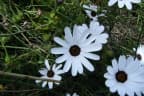
Dimorphotheca pluvialis
Dimorphotheca pluvialis
Safety & Hazards
None known
Cultivation Details
Plants are not frost-resistant and are grown as summer annuals in temperate zones[1]. Prefers a dry, sunny position in a well drained soil rich in organic matter[1]. Prefers a sandy, dry to medium moisture, well-drained soil in full sun[2]. Tolerates drought and hot summers, but dislikes high humidity[2]. Yields in field trials range from 0.5 - 1.5 t/ha, potential maximum yields are 2 - 2.5 t/ha[3]. The seeds of this plant are interesting in that two different forms are produced[4]. The ones usually sown are flat, papery and fly away easily in the wind. They are formed in the centre of the flower by the disk florets[4]. The outer ray florets form seeds which looks like little thorns with thick coats[4]. Under favourable conditions the papery seed of the disk florets germinate in abundance, while the seeds of the ray florets have delayed germination to protect the species against unpredictable conditions in their arid environment[4]. A very ornamental plant, often grown as summer bedding[3].
Propagation
Seed - for the earliest crops, sow in pots in early spring in a greenhouse using a freely-draining potting compost[1]. Seed takes about 3 weeks to germinate at 16°c[1]. Be careful not to overwater at any time since the young plants are prone to damping off[1]. Prick out the seedlings into individual pots as soon as the plants are large enough to handle and plant out in their permanent positions as soon as possible after the last expected frosts. Seed can also be sown in situ in late spring[1]. Cite as: Temperate Plants Database, Ken Fern. temperate.theferns.info. 2026-02-21. <temperate.theferns.info/plant/Dimorphotheca+pluvialis>
Pollinators
Insects
References
- [1]The New RHS Dictionary of Gardening. 1992. — Huxley. A. · MacMillan Press · 1992 · ISBN 0-333-47494-5 ↩︎Excellent and very comprehensive, though it contains a number of silly mistakes. Readable yet also very detailed.
- [2]KemperCentreForHomeGardeningPlantFinder — Missouri Botanical Garden · http://www.mobot.org/gardeninghelp/plantfinder/ ↩︎Basic cultivation details, plant uses, habitat etc for several thousand species of plants, mainly from the temperate zone.
- [3]The National Non-Food Crops Centre Crop Database — http://www.nnfcc.co.uk/crops/pd.cfm ↩︎An excellent on-line information source, with information on over 100 species (as of 2006) of plants being investigated as bio-crops.
- [4]PlantZAfrica.com — http://www.plantzafrica.com ↩︎An excellent site giving detailed descriptions and uses of many S. African plants.