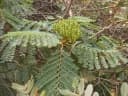
Dimorphandra mollis
Dimorphandra mollis
Safety & Hazards
The seedpods are toxic to cattle[1].
Cultivation Details
Requires a sunny position[1]. Succeeds in poor and dry soils[1]. Established plants are drought tolerant[1]. Newly planted young trees are fairly slow to establish, not reaching more than 2.5 metres tall by the end of the second year[1]. This species has a symbiotic relationship with certain soil bacteria; these bacteria form nodules on the roots and fix atmospheric nitrogen. Some of this nitrogen is utilized by the growing plant but some can also be used by other plants growing nearby[2].
Propagation
Seed - it has a hard seedcoat that needs to be treated in order to allow the seed to imbibe moisture and therefore improve germination rates. This can be done in various ways - abrading or nicking the seedcoat (being careful not to damage the embryo) works well with smaller quantities of seeds, whilst soaking for a few minutes in almost boiling water and then for 12 - 24 hours in warm water is more efficient with larger numbers of seeds. Sow the seed in a semi-shaded position in a nursery seedbed or in individual containers. Germination rates of around 30% or more can be expected within 10 - 30 days[1]. Transplant seedlings to individual containers when they are about 4cm tall. They are normally ready for planting out about 8 - 10 months later[1]. Cite as: Tropical Plants Database, Ken Fern. tropical.theferns.info. 2026-02-20. <tropical.theferns.info/viewtropical.php?id=Dimorphandra+mollis>
Pollinators
Data unavailable
References
- [1]Brazilian Trees. Volume 1. 4th Edition. — Lorenzi. H. · Instituto Plantarum De Estudos Da Flora; Brazil. · 2002 · ISBN 85-86714-17-8 ↩︎Information on 350 species of Brazilian trees. Stunning photographs of each species, brief details on the plant, its uses and how to grow it from seed. A superb work, with the minor irritation that the translation from Portuguese is not of the best.
- [2]Nodulation Plants in GRIN Taxonomy — United States Department of Agriculture · http://www.ars-grin.gov/~sbmljw/cgi-bin/taxnodul.pl?language=en ↩︎An online database listing plants that have either positive or negative reports on root and stem nodulation with nitrogen-fixing bacteria.
- [3]IUCN Red List of Threatened Species — http://www.iucnredlist.org/ ↩︎A list of plants under threat and facing possible extinction, usually with brief details of the threats and information on habitat.
- [4]Diccionario das Plantas Uteis do Brasil — Correa M.P. · Imprensa Nacional; Rio de Janeiro · 1926 ↩︎A massive work in 6 volumes giving details of the various uses of Brazilian plants.
- [5]Dictionary of Economic Plants. — Uphof. J. C. Th. · Weinheim · 1959 · ISBN - ↩︎An excellent and very comprehensive guide but it only gives very short descriptions of the uses without any details of how to utilize the plants. Not for the casual reader.
- [6]Indicador de Madeiras e Plantas Uteis do Brasil. — Fonseca E. T. De · Officinas graphicas Villas-Boas & Co.; Rio de Janeiro · 1922 · http://www.biodiversitylibrary.org ↩︎Brief details of some of the uses of Brazilian plants. It can be downloaded from the Internet.