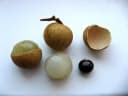
Dimocarpus longan
Dimocarpus longan
Safety & Hazards
None known
Cultivation Details
Whilst the longan succeeds in warm temperate to tropical areas, it requires a distinct cool season of up to 3 months with virtually no frost to initiate blooming[1] and so does not fruit well at low elevations in the tropics[2]. Flowering is poor after a warm winter and in areas with no clear cool season[1]. It needs chilling temperatures of about 7 - 12°c, or a 2 - 3 month period with temperatures about 15 - 22°c and a short dry period in order to stimulate flowering[1]. From fruit set onwards high temperatures do not hamper development, but nights should not be warmer than 20 - 25°c[1]. The temperature range for growth is reported to be 7 - 36°c with the optimum between 18 - 30°c[1]. Ample soil moisture is needed from fruit set until maturity; suitable annual precipitation is about 1,500 - 2,000mm[1]. The annual rainfall range for growth is reported to be 800 - 3,000mm[1]. Prefers some shade from the strongest sun[3]. Succeeds on most fertile soils so long as there is an abundance of moisture[3]. Prefers a pH in the range 5.5 - 6, but can tolerate 5 - 8[4]. Seedling trees take 7 - 10 years to commence bearing fruit, whilst vegetatively propagated trees can fruit in 3 - 5 years[2]. Full-grown trees given sufficient room may yield 180 - 225 kg of fruit in good years. Larger trees have larger crops but if the trees become too tall harvesting is too difficult, and they should be topped[1]. A serious problem with the longan is its irregular bearing - often one good year is followed by 1 or 2 poor years[1]. There are some named varieties[3, 5]. Trees are usually self-fertile[2].
Propagation
Most longan trees are grown from seed. After drying in the shade for 4 days, the seed should be planted without delay, but no more than 2 cm deep, otherwise they may send up more than one sprout[1]. Germination takes place within 7 - 10 days[1]. The seedlings are transplanted to shaded nursery rows the following spring and set in the field 2 - 3 years later during winter dormancy[1]. Air layering. Air-layers bear fruit within 2 - 3 years from planting[1]. Grafting Cite as: Tropical Plants Database, Ken Fern. tropical.theferns.info. 2026-02-20. <tropical.theferns.info/viewtropical.php?id=Dimocarpus+longan>
Pollinators
Data unavailable
References
- [1]World Agroforesty Centre — http://www.worldagroforestry.org/ ↩︎An excellent online database of a huge range of trees giving very good information on each plant - its uses, ecology, identity, propagation, pests etc.
- [2]Perennial Edible Fruits of the Tropics : an Inventory — Martin, F. W.; Campbell, C. W.; Rubertbe, R. M. · U.S. Dept. of Agriculture, Agricultural Research Service · 1987 ↩︎A booklet giving terse details of almost 300 species of edible fruits, plus regional lists of Botanical and Common names for over 2,500 less well-known edible fruits of the tropics.
- [3]The New RHS Dictionary of Gardening. 1992. — Huxley. A. · MacMillan Press · 1992 · ISBN 0-333-47494-5 ↩︎Excellent and very comprehensive, though it contains a number of silly mistakes. Readable yet also very detailed.
- [4]Digital Compendium of Forestry Species of Cambodia — www.digitalspecies.blogspot.com; Phnom Penh · 2008 · http://www.digitalspecies.blogspot.com ↩︎A very detailed booklet, produced in PDF format on the internet, giving information on around 100 species of trees.
- [5]Cornucopia II — Facciola. S. · Kampong Publications, California. · 1998 · ISBN 0-9628087-2-5 ↩︎The second edition of an excellent guide to the edible uses of plants, though it does not give any details of cultivation etc.
- [6]Trees Commonly Cultivated in SE Asia — Jensen. M. · FAO Regional Office, Bangkok. · 1999 · ISBN 974-89377-5-5 ↩︎
- [7]Tropical and Subtropical Trees - A Worldwide Encyclopaedic Guide. — Barwick. M. · Thames & Hudson, London · 2004 · ISBN 0-500-51181-0 ↩︎A superb book, very concise and well written, giving a wealth of information on 400 or more species including descriptions, habitat, cultivation details and plant uses. A wealth of colour photographs bring each plant vividly to life.
- [8]Flora Malesiana Series 1 — Various · Nationaal Herbarium Nederiand, Universiteit Leiden branch · http://www.archive.org ↩︎A massive treatment of the plants of the Malaysian Archipelago. Much of it has been made available to download from the Internet