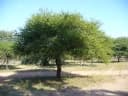
Dichrostachys cinerea
Dichrostachys cinerea
Safety & Hazards
None known
Cultivation Details
A plant of low to medium elevations in the tropics, growing best in moist areas but able to succeed in arid areas as well[1]. It is found at elevations up to 2,000 metres. It grows best in areas where annual daytime temperatures are within the range 15 - 40°c, but can tolerate 10 - 50°c[2]. Plants are usually not frost tolerant[3]. Plants can survive occasional light frosts - the top may be cut back but the plant resprouts freely from the base[4]. It prefers a mean annual rainfall in the range 300 - 500mm, but tolerates 200 - 600mm[2]. These rainfall figures seem much too low - the plant can grow right into the rainforest zone[5, PFAF]. Mean annual rainfall ranges are 200 - 1,400mm, with a dry season that can range from 4 - 10 months[4]. It occurs in areas with a strong seasonal climate[3]. Succeeds in a range of soils from clays, through loams to sandy soils[5]. Requires a well-drained soil[3]. Succeeds in poor soils[5]. Tolerates saline soils[4]. Prefers a pH in the range 5 - 8, tolerating 4.5 - 8.5[2]. Established plants are very drought resistant[1, 3]. Dichrostachys cinerea is an ornamental plant that is also often used in soil stabilization programmes[4]. It has been spead by human cultivation through much of the tropical zone, and has often escaped from cultivatio, becoming a noxious weed in at least one country (Cuba)[4].. Seed production starts when plants are still very young. Each plant, as it grows larger, can produce a large number of seeds almost all year round - these can germinate freely and can also remain dormant in the soil for a long time[6].The plant can also spread very rapidly and aggressively by means of suckers. It can encroach rapidly on overgrazed, trampled ground and on old lands where the grass cover has been removed. It is difficult to eradicate as it shoots again from portions of root[3, 5]. In certain situations, mechanical or chemical control measures are the only ways to control the potentially serious weed[3]. A moderately slow-growing tree[7]. The growth of the plants is very fast[6]. For fuel wood plantations, dune stabilization, ravine reforestation, or erosion control, the spacing should be 3 x 5 metres. Dense plantings help stabilize gully plugs and check-dams[3]. For soil conservation, the species should not be disturbed in any way. Its prolific root suckers will then provide natural spread for complete ground cover within a few years[3]. The plant often suckers freely, has moderately vigorous coppicing ability and can also be pollarded and lopped[3]. It usually survives fire by suckering and resprouting from the base[4]. A plant in the range of 7 - 8.5 cm collar diameter is suitable for coppicing, and the whole plant can be harvested 15cm above ground level[3]. The number of regenerated shoots varies between 5 and 9, of which 2 - 3 branches attain better growth in height, diameter and biomass[3]. To get maximum fuel biomass, the plants should be harvested at 10 years[3]. An average yield of 22.8 tonnes (11.1 tonnes when dried) of firewood may be expected on the 6th year from 1 hectare of wasteland[3]. Yields of about 1 kilo of seed pods per mature plant can be expected[3]. A fire-resistant species[3]. This species is very variable over its great range and has been subdivided into no less than 10 subspecies and many varieties[8]. A favourite plant to train as a bonsai[3]. This species has a symbiotic relationship with certain soil bacteria, these bacteria form nodules on the roots and fix atmospheric nitrogen. Some of this nitrogen is utilized by the growing plant but some can also be used by other plants growing nearby[9].
Propagation
Seed - A fraction of seeds exhibit polyembryony with usually 2, sometimes 3, or rarely more embryos; the extent of polyembryony seems to be positively correlated with the number of seed produced[3]. Natural regeneration is strongest by root suckers. Within a period of 10 years, an individual of this species can produce 130 new stems in a radius of 15 m by its root suckers. Artificial propagation by transplanting root suckers or by using root cuttings is likewise the easiest and usually most successful method of propagation. Orthodox seed storage behaviour; little loss in viability during 26 years of hermetic storage at room temperature. Add ash to stored seed to reduce insect damage. Can be stored for up to 10 years at room temperature if kept dry and free from insects Direct sowing of seed is also possible. The freshly collected ripe seeds take long to germinate (15-20 days), mainly due to a thick seed coat. Scarified seeds give better germination, and a pre-treatment of 25 minutes in concentrated sulphuric acid gives optimum germination of 3-7 days for freshly collected seeds. Three-year-old seeds require only a 15-minute pre-treatment for optimum germination. Under controlled conditions, more than 75% germination may be expected. As soon as the pods ripen on the tree, they should be collected and the seeds taken out, dried and stored. This way, a reasonable amount of seeds could be saved from insect attack. About 1 million seeds/year are expected from a plant and most of the seeds are viable. Cite as: Tropical Plants Database, Ken Fern. tropical.theferns.info. 2026-02-20. <tropical.theferns.info/viewtropical.php?id=Dichrostachys+cinerea>
Pollinators
Bats, Bees
References
- [1]The New RHS Dictionary of Gardening. 1992. — Huxley. A. · MacMillan Press · 1992 · ISBN 0-333-47494-5 ↩︎Excellent and very comprehensive, though it contains a number of silly mistakes. Readable yet also very detailed.
- [2]Ecocrop — http://ecocrop.fao.org/ecocrop/srv/en/home ↩︎Basic information on a wide range of useful plants, plus details of environmental needs where available.
- [3]World Agroforesty Centre — http://www.worldagroforestry.org/ ↩︎An excellent online database of a huge range of trees giving very good information on each plant - its uses, ecology, identity, propagation, pests etc.
- [4]Invasive Species Compendium — http://www.cabi.org ↩︎An immense resource - in depth information on over 900 species of invasive plants (it also has information on animals, fungi etc).
- [5]Trees and Shrubs of the Sahel. Their Characteristics and Uses. — von Maydell H. · Deutsche Gesellschaft fur Technische Zusammenarbeit; Germany · 1990 · ISBN 3-8236-1198-4 ↩︎A well-researched book, usually with more than one photograph of each species and good information on the plant and its uses.
- [6]IUCN Red List of Threatened Species — http://www.iucnredlist.org/ ↩︎A list of plants under threat and facing possible extinction, usually with brief details of the threats and information on habitat.
- [7]African Flowering Plants Database — Conservatoire et Jardin Botaniques. · http://www.ville-ge.ch/musinfo/bd/cjb/africa/recherche.php ↩︎Contains information on over 150,000 plant names (including synonyms) giving a description and habitat, plus a distribution map.
- [8]Mansfeld's Database of Agricultural and Horticultural Plants — http://mansfeld.ipk-gatersleben.de/pls/htmldb_pgrc/f?p=185:3:4292127278597336 ↩︎Terse details of a huge range of useful plants.
- [9]Nodulation Plants in GRIN Taxonomy — United States Department of Agriculture · http://www.ars-grin.gov/~sbmljw/cgi-bin/taxnodul.pl?language=en ↩︎An online database listing plants that have either positive or negative reports on root and stem nodulation with nitrogen-fixing bacteria.
- [10]Gemsbok Bean and Kalahari Truffle — Leffers A. · Gamsberg MacMillan; Namibia. · 2003 · ISBN 99916-0-491-X ↩︎Details of the traditional uses of over 200 species of plants in northeastern Namibia. Written for the non-expert, there is usually at least one photograph with each plant entry.
- [11]Traditional herbal remedies and dietary spices from Cameroon as novel sources of larvicides against filariasis mosqu — Roman Pavela et al · 2016 · http://10.1007/s00436-016-5254-4 ↩︎
- [12]The Leguminosae; A Source Book of Characteristics, Uses and Nodulation — Allen O.N.; Allen E.K. · University of Wisconsin · 1981 · ISBN 0-333-32221-5 ↩︎An amazing and comprehensive work, giving a brief guide to the many genera of the family Fabaceae and also the principle uses of the genus.
- [13]Dichrostachys cinerea as a possible energy crop - facts and figures — Pedroso D.T. & Kaltschmitt M. · 2011 · http://10.1007/s13399-011-0026-y ↩︎
- [PFAF]Plants for a Future — pfaf.org ↩︎