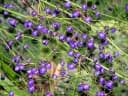
Dianella longifolia
Dianella longifolia
Safety & Hazards
None known
Cultivation Details
Dianella longifolia has a very wide range, from the temperate climate of Tasmania, north through eastern Australia to the tropics of Queensland and Northern Territory. Plants are said to tolerate occasional temperatures down to at least -7°c in Australian gardens[1] . Succeeds in ordinary garden soil in sun or dappled shade[2]. Requires a well-drained neutral to acid soil[3]. Requires a sunny sheltered position when grown outdoors in cooler regions of the temperate zone[4]. Plants can succeed in heavy shade areas with hot summers, but in cooler areas will need a sunnier position[1, PFAF] Although not very cold-tolerant, this species can survive in sheltered stable environments in dappled shade, such as a woodland, if temperatures do not drop far below zero for long periods[2]. A polymorphic species with several varieties recognised[1], some forms are very ornamental[5].
Propagation
Seed - pre-soak for 24 hours in luke-warm water and then sow in spring in gentle heat in a greenhouse. Germination usually takes place within 1 - 3 months at 25°c[4]. When large enough to handle, prick the seedlings out into individual pots and grow them on in the greenhouse for at least their first two years. When large enough, plant them out into their permanent positions in late spring or early summer. Division as the plants come into growth in the spring[3]. Larger clumps can be replanted direct into their permanent positions, though it is best to pot up smaller clumps and grow them on in a cold frame until they are rooting well. Plant them out in the spring. Cite as: Temperate Plants Database, Ken Fern. temperate.theferns.info. 2026-02-21. <temperate.theferns.info/plant/Dianella+longifolia>
Pollinators
Data unavailable
References
- [1]Australian Native Plants. — Wrigley. J. W. and Fagg. M. · Collins. (Australia) · 1988 · ISBN 0-7322-0021-0 ↩︎A lovely book, written in order to encourage Australian gardeners to grow their native plants. A little bit of information for the plant project.
- [2]The New RHS Dictionary of Gardening. 1992. — Huxley. A. · MacMillan Press · 1992 · ISBN 0-333-47494-5 ↩︎Excellent and very comprehensive, though it contains a number of silly mistakes. Readable yet also very detailed.
- [3]The RHS Gardener's Encyclopedia of Plants and Flowers — Brickell. C. · Dorling Kindersley Publishers Ltd. · 1990 · ISBN 0-86318-386-7 ↩︎Excellent range of photographs, some cultivation details but very little information on plant uses.
- [4]Focus on Plants. Volume 5. (formerly 'Growing from seed') — Bird. R. (Editor) · Thompson and Morgan. · 1991 · ISBN - ↩︎Very readable magazine with lots of information on propagation. A good article on Corydalis spp.
- [5]RHS Dictionary of Plants plus Supplement. 1956 — F. Chittendon. · Oxford University Press · 1951 · ISBN - ↩︎Comprehensive listing of species and how to grow them. Somewhat outdated, it has been replaced in 1992 by a new dictionary (see [ 200 ]).
- [6]Flora of Australia — http://www.anbg.gov.au/abrs/abif/flora/ ↩︎The full information from the Flora of Australia - on-line. An excellent resource.
- [7]Flora of Victoria. — Ewart. A. J. · University Press; Melbourne · 1930 ↩︎A flora of eastern Australia, it is rather short on information that is useful to the plant project.
- [8]Useful Wild Plants in Australia. — Cribb. A. B. and J. W. · William Collins Pty Ltd. Sidney · 1981 · ISBN 0-00-216441-8 ↩︎A very readable book.
- [PFAF]Plants for a Future — pfaf.org ↩︎