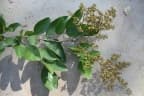
Dialium guineense
Dialium guineense
Safety & Hazards
None known
Cultivation Details
A plant of the drier areas of the tropics, where it is found at elevations up to 1,000 metres. It grows best in areas where annual daytime temperatures are within the range 21 - 25°c, but can tolerate 15 - 30°c[1]. It prefers a mean annual rainfall in the range 900 - 1,800mm, but tolerates 800 - 2,600mm[2, 1]. Prefers a humid, fertile, deep soil in full sun[3]. Prefers a pH in the range 5.5 - 7, tolerating 5 - 7.5[1]. The plant usually fruits abundantly[1]. The tree is hardwood and grows very slowly so it is important that care is taken when harvesting this from the wild. Always leave some to grow into mature trees to provide seed for the future[4]. Harvesting the tree for its wood is difficult because the wood is dense and hard. It often has tall butt flares, which have to be slashed before cutting, as much of the wood would be wasted if the trunk were cut above them. The logs cannot be transported by river as they sink in water[2]. This species has a symbiotic relationship with certain soil bacteria, these bacteria form nodules on the roots and fix atmospheric nitrogen. Some of this nitrogen is utilized by the growing plant but some can also be used by other plants growing nearby[5].
Propagation
Seed - Cite as: Tropical Plants Database, Ken Fern. tropical.theferns.info. 2026-02-20. <tropical.theferns.info/viewtropical.php?id=Dialium+guineense>
Pollinators
Data unavailable
References
- [1]Ecocrop — http://ecocrop.fao.org/ecocrop/srv/en/home ↩︎Basic information on a wide range of useful plants, plus details of environmental needs where available.
- [2]World Agroforesty Centre — http://www.worldagroforestry.org/ ↩︎An excellent online database of a huge range of trees giving very good information on each plant - its uses, ecology, identity, propagation, pests etc.
- [3]Tropical and Subtropical Trees - A Worldwide Encyclopaedic Guide. — Barwick. M. · Thames & Hudson, London · 2004 · ISBN 0-500-51181-0 ↩︎A superb book, very concise and well written, giving a wealth of information on 400 or more species including descriptions, habitat, cultivation details and plant uses. A wealth of colour photographs bring each plant vividly to life.
- [4]Manual for the Propagation and Cultivation of Medicinal Plants of Ghana. — Amponsah K., Crensil O’R., Odamtten G.T., Ofusohene-Djan W. · Aburi Botanic Garden; Ghana. · 2002 ↩︎A nice, concise guide, it details some of the medicinal uses of plants from Ghana. Available as a PDF file on the Internet.
- [5]The New RHS Dictionary of Gardening. 1992. — Huxley. A. · MacMillan Press · 1992 · ISBN 0-333-47494-5 ↩︎Excellent and very comprehensive, though it contains a number of silly mistakes. Readable yet also very detailed.
- [6]African Flowering Plants Database — Conservatoire et Jardin Botaniques. · http://www.ville-ge.ch/musinfo/bd/cjb/africa/recherche.php ↩︎Contains information on over 150,000 plant names (including synonyms) giving a description and habitat, plus a distribution map.
- [7]Perennial Edible Fruits of the Tropics : an Inventory — Martin, F. W.; Campbell, C. W.; Rubertbe, R. M. · U.S. Dept. of Agriculture, Agricultural Research Service · 1987 ↩︎A booklet giving terse details of almost 300 species of edible fruits, plus regional lists of Botanical and Common names for over 2,500 less well-known edible fruits of the tropics.
- [8]Cornucopia II — Facciola. S. · Kampong Publications, California. · 1998 · ISBN 0-9628087-2-5 ↩︎The second edition of an excellent guide to the edible uses of plants, though it does not give any details of cultivation etc.