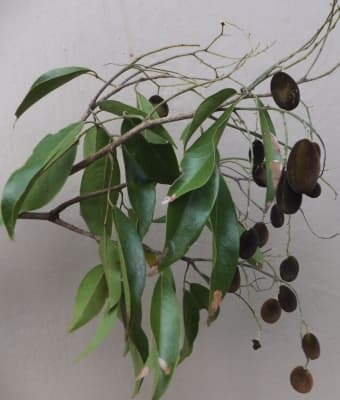
Dialium cochinchinense
Dialium cochinchinense
Safety & Hazards
None known
Cultivation Details
A plant of the lowland tropics, where it is found at elevations up to 800 metres[1]. Prefers a well-drained soil[2]. This species has a symbiotic relationship with certain soil bacteria, these bacteria form nodules on the roots and fix atmospheric nitrogen. Some of this nitrogen is utilized by the growing plant but some can also be used by other plants growing nearby[3].
Propagation
Seed - it probably has a long viability. The seeds have hard seed coat, which must be scarified before the seeds will imbibe water and germinate. Any method (manual nicking, filing or burning, hot water or sulphuric acid) used for pre-treatment of hard seed can be applied. There are presumably inhibitors in the fruit flesh, but these will naturally be removed by processing and cleaning the seed. However, attempts to sow the whole fruit in order to avoid the tedious pre-treatment will most likely give very low germination[2]. The seed is usually sown in individual, deep containers. Germination is quick; at optimal conditions and after proper pre-treatment, germination commences 1 - 2 days after sowing, and seedlings with unfolded cotyledons and two persistent leaves have developed after 10 - 14 days[2]. Cite as: Tropical Plants Database, Ken Fern. tropical.theferns.info. 2026-02-20. <tropical.theferns.info/viewtropical.php?id=Dialium+cochinchinense>
Pollinators
Insects
References
- [1]World Agroforesty Centre — http://www.worldagroforestry.org/ ↩︎An excellent online database of a huge range of trees giving very good information on each plant - its uses, ecology, identity, propagation, pests etc.
- [2]Seed Leaflets — Various · Forest & Landscape. Denmark · http://en.sl.life.ku.dk/Publikationer/Udgivelser/PopulaerPublikationer.aspx?katid={D28373CC-6EF3-4EF8-B097-6D83FABF209E}&serieid={9F1C3DB1-6E7B-4CF1-AF53-F480B0CB40EF}&sort=title ↩︎A series of leaflets, jointly produced by the University of Copenhagen and the Royal Botanic Gardens at Kew, focussing on seed information for a number species, but also giving a lot of other information about each plant.
- [3]The New RHS Dictionary of Gardening. 1992. — Huxley. A. · MacMillan Press · 1992 · ISBN 0-333-47494-5 ↩︎Excellent and very comprehensive, though it contains a number of silly mistakes. Readable yet also very detailed.
- [4]Trees of Laos and Vietnam - A Field Guide to 100 species. — Hoang Van Sam; Khamseng Nanthavong; Kessler P.J.A. · Blumea · 2004 ↩︎A detailed guide, with excellent line-drawings, to 100 of the more important trees of Laos and Vietnam. A very good work, giving lots of information about each plant. Originally published in the journal Blumea, it is available as a PDF on the Interne
- [5]Global Tree Campaign - 40 Species in Trade — http://www.unep-wcmc.org/trees/trade/40_species_in_trade.htm ↩︎Information on the habitats, uses and some cultivation notes for 40 species of timber trees.
- [6]Biotik, Laos — http://biotik.org/species_list_laos.html ↩︎Information on more than 100 species of Laotian trees.
- [7]IUCN Red List of Threatened Species — http://www.iucnredlist.org/ ↩︎A list of plants under threat and facing possible extinction, usually with brief details of the threats and information on habitat.
- [8]Woods of Northeastern Peru — Williams L. · Field Museum Press; Chicago. · 1936 · http://www.biodiversitylibrary.org/ ↩︎Gives information on the properties of the wood of well over 1,000 species of woody plants from northeastern Peru. Can be downloaded from the Internet.
- [9]Timber Notes - Heavy Hardwoods II (Kekatong, Keranji, Merbau, Penaga, Resak) — Choo K.T.; Lim S.C.; Gan K.S. · Forest Research Institute; Malaysia · 1999 · http://info.frim.gov.my/cfdocs/infocenter/booksonline/index.cfm?menu=ttb · ISBN 139-258 ↩︎The properties of several Maleysian timbers. It can be downloaded from the Internet.