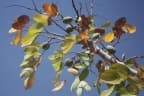
Detarium microcarpum
Detarium microcarpum
Safety & Hazards
The bark is said to be poisonous[1].
Cultivation Details
A tree of hot, tropical savannahs, it is most common in regions with an annual rainfall of 600 - 1,000 mm[2]. In the wild, plants are mainly found on shallow, stony and lateritic soils[2]. Probably requires a well-drained soil[PFAF]. Trees coppice well[2]. Regenerates well from shoots produced by the trunk or roots[2]. Shoots from the trunk are much more vigorous than seedlings and can reach a height of 1.5 - 2 metres in 1 - 2 years[2]. Average seedling height after 3 years is 0.6 metres, and the seedling may reach 1.5 metres in 4 years[2]. Young trees are regularly cut down on agricultural land because of the horizontal rooting system[2]. The trees are pruned to stimulate fruit production on young branches[2]. The trees are either cut at soil level or at 10 - 60 cm height; suckers formed on high stumps survive bush fires better than root suckers[2]. A tree can produce 675 fruits on average, i.e. about 7 kg[2]. Trees often produce seedless fruits[2]. This species has a symbiotic relationship with certain soil bacteria, these bacteria form nodules on the roots and fix atmospheric nitrogen. Some of this nitrogen is utilized by the growing plant but some can also be used by other plants growing nearby[3].
Propagation
Seed - germinates best if pre-treated. To break dormancy, stored seeds are soaked in sulphuric acid for 30 minutes, followed by thorough washing and soaking in water for 24 hours[2]. Scarification with sand and additional fungicide treatment also improves germination[2]. Dormancy can also be broken by boiling the seeds for 7 minutes followed by soaking in lukewarm water for 24 hours[2]. In a nursery, germination started 8 - 10 days after sowing. After 47 days, 71 - 100% of the seeds sown in polythene bags had germinated[2]. Natural germination is hampered by bush fires and dry spells. Direct-sown plantations have not been successful because of the slow early growth[2]. Seeds can be stored at ambient temperature (26°C) for 5 years[2]. Grafting adult twigs or shoots[2]. Cite as: Tropical Plants Database, Ken Fern. tropical.theferns.info. 2026-02-20. <tropical.theferns.info/viewtropical.php?id=Detarium+microcarpum>
Pollinators
Insects
References
- [1]The Leguminosae; A Source Book of Characteristics, Uses and Nodulation — Allen O.N.; Allen E.K. · University of Wisconsin · 1981 · ISBN 0-333-32221-5 ↩︎An amazing and comprehensive work, giving a brief guide to the many genera of the family Fabaceae and also the principle uses of the genus.
- [2]Protabase - Plant Resources of Tropical Africa. — http://www.prota.org ↩︎An excellent on-line database with detailed information on over 3,200 species of useful plants of Africa.
- [3]The New RHS Dictionary of Gardening. 1992. — Huxley. A. · MacMillan Press · 1992 · ISBN 0-333-47494-5 ↩︎Excellent and very comprehensive, though it contains a number of silly mistakes. Readable yet also very detailed.
- [4]African Flowering Plants Database — Conservatoire et Jardin Botaniques. · http://www.ville-ge.ch/musinfo/bd/cjb/africa/recherche.php ↩︎Contains information on over 150,000 plant names (including synonyms) giving a description and habitat, plus a distribution map.
- [5]The Useful Plants of West Tropical Africa. — Burkil. H. M. · Royal Botanic Gardens; Kew. · 1985 - 2004 ↩︎Brief descriptions and details of the uses of over 4,000 plants. A superb, if terse, resource, it is also available electronically on the Web - see http://www.aluka.org/
- [6]Seed Leaflets — Various · Forest & Landscape. Denmark · http://en.sl.life.ku.dk/Publikationer/Udgivelser/PopulaerPublikationer.aspx?katid={D28373CC-6EF3-4EF8-B097-6D83FABF209E}&serieid={9F1C3DB1-6E7B-4CF1-AF53-F480B0CB40EF}&sort=title ↩︎A series of leaflets, jointly produced by the University of Copenhagen and the Royal Botanic Gardens at Kew, focussing on seed information for a number species, but also giving a lot of other information about each plant.
- [7]Perennial Edible Fruits of the Tropics : an Inventory — Martin, F. W.; Campbell, C. W.; Rubertbe, R. M. · U.S. Dept. of Agriculture, Agricultural Research Service · 1987 ↩︎A booklet giving terse details of almost 300 species of edible fruits, plus regional lists of Botanical and Common names for over 2,500 less well-known edible fruits of the tropics.
- [8]Dictionary of Economic Plants. — Uphof. J. C. Th. · Weinheim · 1959 · ISBN - ↩︎An excellent and very comprehensive guide but it only gives very short descriptions of the uses without any details of how to utilize the plants. Not for the casual reader.
- [PFAF]Plants for a Future — pfaf.org ↩︎