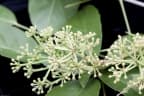
Dendropanax arboreus
Dendropanax arboreus
Safety & Hazards
None known
Cultivation Details
A plant of low to medium elevations in the tropics, it grows in regions where there is an average annual temperature of 26°c, with a maximum temperature of 36.7°c and a minimum of 14.9°c[1]. Average annual precipitation is approximately 1,288mm, ranging from between 900 - 1,800mm[1]. The tree grows naturally from sea level to 1,700 metres[1]. The tree grows in calcareous soils with outcropping rocks in the wild[1]. The tree begins to yield flowers and fruits between 4 and 5 years of age[1]. It can then flower and fruit nearly all year round[2]. A very variable tree, both in foliage and inflorescence[3].
Propagation
Seed - under humid conditions, the fresh seeds germinate at 70% without pre-treatment. A heterogeneous sample of seeds germinated approximately 18 days after sowing[1]. The ripe fruits are collected by climbing the trees and using poles with metal hooks to remove them[1]. The pulp is removed from the pulpy fruits by hand inside a bucket of water[1]. Resulting impurities float and are gathered with a strainer. Good pyrenes sink[1]. Subsequently, seeds are dried in the sun in ventilated areas for 1 or 2 hours, depending on lighting conditions. The seeds within the pyrenes remain viable for approximately 15 months when stored under ambient conditions[1]. With longer storage their viability quickly diminishes[1]. Cite as: Tropical Plants Database, Ken Fern. tropical.theferns.info. 2026-02-20. <tropical.theferns.info/viewtropical.php?id=Dendropanax+arboreus>
Pollinators
Bees
References
- [1]Tropical Tree Seed Manual — Vosso. J. Editor. · USDA Forest Service. · 2002 · http://www.rngr.net/Publications/ttsm ↩︎An extremely good guide, it can also be downloaded in its entirety from the address shown above.
- [2]Common Trees of Puerto Rico and the Virgin Islands — Little E.L.; Wadsworth F.H. · USDA, Forest Service; Washington. · 1964 ↩︎Contains detailed information, and usually an illustration, on 250 tree species, including both native and exotic species.
- [3]Flora of Guatemala — Standley P.C. & J. A. Steyermark · 1946 - 1976 · http://www.archive.org/ ↩︎A superb reference, though somewhat dated. Gives lots of plant uses as well as information on plant habit and habitat. The entire flora (13 volumes) can now be downloaded from http://www.archive.org/
- [4]Dictionary of Economic Plants. — Uphof. J. C. Th. · Weinheim · 1959 · ISBN - ↩︎An excellent and very comprehensive guide but it only gives very short descriptions of the uses without any details of how to utilize the plants. Not for the casual reader.
- [5]Tropical Timbers of the World. Ag. Handbook No. 607. — Chudnoff. Martin. · USDA Forest Service. Wisconsin. · 1984 ↩︎Terse details on the properties of the wood of almost 400 species of trees from the Tropics.