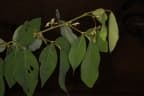
Dendrolobium umbellatum
Dendrolobium umbellatum
Safety & Hazards
None known
Cultivation Details
A plant of the lowland tropics, where it is found at elevations up to 600 metres. It grows best in areas where annual daytime temperatures are within the range 22 - 34°c, but can tolerate 13 - 40°c[1]. It prefers a mean annual rainfall in the range 850 - 1,500mm, but tolerates 600 - 1,750mm[1]. Succeeds in full sun and in light shade[1]. Succeeds in light and medium soils of moderate or low fertility[1]. Found in the wild on sandy and rocky soils[2]. Prefers a pH in the range 5.5 - 8, tolerating 4.5 - 9[1]. Established plants are drought tolerant and able to withstand strong winds and coastal salt spray[1]. This species has a symbiotic relationship with certain soil bacteria, these bacteria form nodules on the roots and fix atmospheric nitrogen. Some of this nitrogen is utilized by the growing plant but some can also be used by other plants growing nearby[3].
Propagation
Seed - Cite as: Tropical Plants Database, Ken Fern. tropical.theferns.info. 2026-02-20. <tropical.theferns.info/viewtropical.php?id=Dendrolobium+umbellatum>
Pollinators
Data unavailable
References
- [1]Ecocrop — http://ecocrop.fao.org/ecocrop/srv/en/home ↩︎Basic information on a wide range of useful plants, plus details of environmental needs where available.
- [2]Plants of Southeast Asia — http://www.asianplant.net/ ↩︎Excellent site with brief information on the plant, its range, habitat and uses, plus phots of specimens, close-ops of flowers and leaves etc,
- [3]The New RHS Dictionary of Gardening. 1992. — Huxley. A. · MacMillan Press · 1992 · ISBN 0-333-47494-5 ↩︎Excellent and very comprehensive, though it contains a number of silly mistakes. Readable yet also very detailed.
- [4]Plant Resources of Southeast Asia — http://proseanet.org/ ↩︎Lots of information on the uses of the plants of SE Asia.
- [5]Medicinal Plants in Papua New Guinea — World Health Organisation · 2009 · ISBN 978-92-9061-249-0 ↩︎Traditional medicinal uses of 126 species from Papua New Guinea, including information on modern research into the plants.