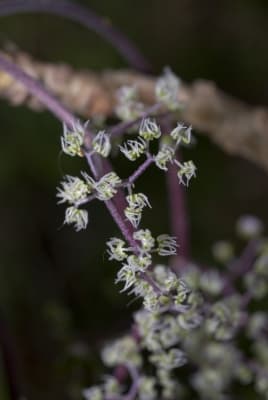
Dendrocnide meyeniana
Dendrocnide meyeniana
Safety & Hazards
The trees, especially when young, have stinging hairs. The sting can be intensely painful and the pain can recur, with reducing intensity, over a period of several weeks[1]. Contact with the leaves causes breaking of the tips of the hairs and a poison is released that causes immediate and intense skin irritation. The stings are painful and may cause the formation of blisters, immediate and possibly progressing to confluence[2].
Cultivation Details
Plants in this genus are essentially lowland primary forest species preferring slightly moist and somewhat shady habitats[3]. A dioecious species, both male and female forms need to be grown if fruit and seed are required[4].
Propagation
Seed - easy. Cuttings root easily - simply thrusting a branch into moist ground will usually result in it rooting[3]. Cite as: Tropical Plants Database, Ken Fern. tropical.theferns.info. 2026-02-20. <tropical.theferns.info/viewtropical.php?id=Dendrocnide+meyeniana>
Pollinators
Data unavailable
References
- [1]Wild Food in Australia. — Cribb. A. B. and J. W. · Fontana · 1976 · ISBN 0-00-634436-4 ↩︎A very good pocket guide.
- [2]Philippine Medicinal Plants — http://www.stuartxchange.org/CompleteList.html ↩︎A lovely site, giving brief details on the medicinal uses of several hundred (over 400 at the last count) plants in the Philippines, plus a picture of each plant.
- [3]Plant Resources of Southeast Asia — http://proseanet.org/ ↩︎Lots of information on the uses of the plants of SE Asia.
- [4]The Gardens' Bulletin Vol. 25 — Botanic Gardens; Singapore · 1969 · http://www.biodiversitylibrary.org/Default.aspx ↩︎A botanical journal - this issue includes a treatment of the genera Dendrocnide and Laportea. It can be downloaded from the Internet.
- [PFAF]Plants for a Future — pfaf.org ↩︎