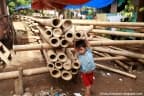
Dendrocalamus asper
Dendrocalamus asper
Safety & Hazards
None known
Cultivation Details
A plant of moist areas in the tropics and subtropics, where it can be found from low elevations up to 1,500 metres, though it grows best at an elevation of 400 - 500 metres[1, 2]. It grows best in areas where annual daytime temperatures are within the range 20 - 27°c, but can tolerate 15 - 34°c[2]. It prefers a mean annual rainfall in the range 1,800 - 3,600mm, but tolerates 1,200 - 4,500mm[2]. Succeeds in any type of soil of at least moderate fertility, though it grows better on heavy soils with good drainage[1, 2]. In Thailand, according to local farmers, the plant will grow well on sandy and rather acidic soils[1]. Prefers a pH in the range 5 - 6.5, tolerating 4.5 - 7[2]. Bamboos have an interesting method of growth. Each plant produces a number of new stems annually - these stems grow to their maximum height in their first year of growth, subsequent growth in the stem being limited to the production of new side branches and leaves. In the case of some mature tropical species the new stem could be as much as 30 metres tall, with daily increases in height of 30cm or more during their peak growth time. This makes them some of the fastest-growing species in the world[PFAF]. Initially, a young plant raised from a lateral branch cutting will produce small shoots which will develop into small culms[1]. As the plant grows older, so the culms produced each year increase in size and quantity until full-size culms appear five or six years after planting[1]. A mature clump may attain a diameter of 3 metres or more and contains about 60 culms[1]. A culm becomes mature when 3 - 4 years old[1]. A good healthy clump can produce several shoots annually[1]. Yields of 10 - 11 tonnes per hectare of bamboo shoots have been reported from Thailand[2]. Bamboos in general are usually monocarpic, living for many years before flowering, then flowering and seeding profusely for a period of 1 - 3 years before usually dying. This species usually flowers when around 100 - 120 years old[3].
Propagation
Seed - many, if not all, members of this genus have a short viability and should be sown within 2 - 3 months of harvest. Sow in containers in a lightly shaded position and only just cover. Germination usually takes place readily. Prick out into individual pots as soon as the plants are large enough to handle. Plant out into permanent positions when 20cm tall. Plants may remain in their low-growing juvenile state for several years - cutting the culms to the ground level can stimulate taller adult growth[4]. Rhizome, culm and branch cuttings[1]. The propagules are raised in the nursery and after they have produced roots they are planted out in the field before or during the first half of the rainy season[1]. Cite as: Tropical Plants Database, Ken Fern. tropical.theferns.info. 2026-02-20. <tropical.theferns.info/viewtropical.php?id=Dendrocalamus+asper>
Pollinators
Wind
References
- [1]Plant Resources of Southeast Asia — http://proseanet.org/ ↩︎Lots of information on the uses of the plants of SE Asia.
- [2]Ecocrop — http://ecocrop.fao.org/ecocrop/srv/en/home ↩︎Basic information on a wide range of useful plants, plus details of environmental needs where available.
- [3]Protabase - Plant Resources of Tropical Africa. — http://www.prota.org ↩︎An excellent on-line database with detailed information on over 3,200 species of useful plants of Africa.
- [4]The New RHS Dictionary of Gardening. 1992. — Huxley. A. · MacMillan Press · 1992 · ISBN 0-333-47494-5 ↩︎Excellent and very comprehensive, though it contains a number of silly mistakes. Readable yet also very detailed.
- [5]The Gardens' Bulletin Vol. 16 — The Botanic Gardens; Singapore · 1958 · http://www.biodiversitylibrary.org/Default.aspx ↩︎A botanical journal - this issue includes a treatment of the Bamboos in Malaya and the Myristicaceae in Malaya. It can be downloaded from the Internet.
- [6]Cornucopia II — Facciola. S. · Kampong Publications, California. · 1998 · ISBN 0-9628087-2-5 ↩︎The second edition of an excellent guide to the edible uses of plants, though it does not give any details of cultivation etc.
- [PFAF]Plants for a Future — pfaf.org ↩︎