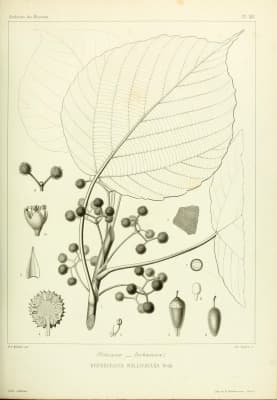
Debregeasia wallichiana
Debregeasia wallichiana
Safety & Hazards
Unlike many species in the nettle family (Urticaceae), members of this genus do not have stinging hairs[1].
Cultivation Details
Debregeasia wallichiana is native to mainly subtropical regions in southern Asia, though there are reports that it can be found at elevations up to 2,100 metres in the Himalayas. The species is probably not very hardy in the temperate zone, but is probably worth trying in areas with mild winters, where it might be possible to grow it outdoors, especially if it is given the protection of a warm wall. Prefers a fertile well-drained loam with some shelter at the hottest part of the day[2]. A handsome plant ; the inflorescence is orange, and the under surface of the large leaves is snow-white[3].
Propagation
Seed - sow late winter to mid-summer in a greenhouse and only just cover the seed. Germination usually takes place within 1 - 2 months at 20°c[4]. When they are large enough to handle, prick the seedlings out into individual pots and grow them on in the greenhouse for at least their first winter. Plant them out into their permanent positions in late spring or early summer, after the last expected frosts. Softwood cuttings in early summer[5]. Cite as: Temperate Plants Database, Ken Fern. temperate.theferns.info. 2026-02-21. <temperate.theferns.info/plant/Debregeasia+wallichiana>
Pollinators
Data unavailable
References
- [1]Flora of China — Missouri Botanical Garden Press; St. Louis. · 1994 · http://flora.huh.harvard.edu/china/ ↩︎An excellent, comprehensive resource in 25 volumes. In addition to the botanical information the flora also gives basic information on habitat and some uses. An on-line version is also available.
- [2]The New RHS Dictionary of Gardening. 1992. — Huxley. A. · MacMillan Press · 1992 · ISBN 0-333-47494-5 ↩︎Excellent and very comprehensive, though it contains a number of silly mistakes. Readable yet also very detailed.
- [3]A Handbook to the Flora of Ceylon — Trimen H.; continued by Hooker J.D. · Dulau and Co; London. · 1898 · http://www.biodiversitylibrary.org ↩︎Very dated, but still a useful work. It can be downloaded from the Internet.
- [4]Focus on Plants. Volume 5. (formerly 'Growing from seed') — Bird. R. (Editor) · Thompson and Morgan. · 1991 · ISBN - ↩︎Very readable magazine with lots of information on propagation. A good article on Corydalis spp.
- [5]RHS Dictionary of Plants plus Supplement. 1956 — F. Chittendon. · Oxford University Press · 1951 · ISBN - ↩︎Comprehensive listing of species and how to grow them. Somewhat outdated, it has been replaced in 1992 by a new dictionary (see [ 200 ]).
- [6]A Manual of Indian Timbers. — Gamble. J. S. · Bishen Singh Mahendra Pal Singh · 1972 · ISBN - ↩︎First written in the 19th century, but still a classic, giving a lot of information on the uses and habitats of Indian trees. Not for the casual reader.