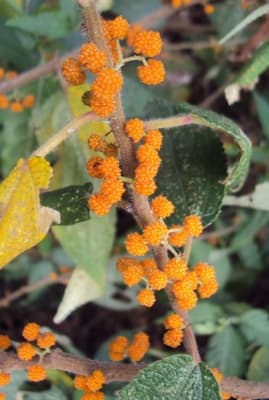
Debregeasia longifolia
Debregeasia longifolia
Safety & Hazards
Unlike many species in the nettle family (Urticaceae), members of this genus do not have stinging hairs[1].
Cultivation Details
Debregeasia longifolia is a plant of low to moderate elevations in the tropics and subtropics. Plants can tolerate occasional, short-lived lows to about -5°c and can be grown outdoors in the milder regions of the temperate zome[2]. Prefers a fertile well-drained loam with some shelter at the hottest part of the day[3]. A very variable species[1]. A dioecious species, both male and female forms must be grown if seed and fruit is required.
Propagation
Seed - sow late winter to mid-summer in a greenhouse and only just cover the seed. Germination usually takes place within 1 - 2 months at 20°c[4]. When they are large enough to handle, prick the seedlings out into individual pots and grow them on in the greenhouse for at least their first winter. Plant them out into their permanent positions in late spring or early summer, after the last expected frosts. Softwood cuttings in early summer[5]. Cite as: Temperate Plants Database, Ken Fern. temperate.theferns.info. 2026-02-21. <temperate.theferns.info/plant/Debregeasia+longifolia>
Pollinators
Data unavailable
References
- [1]Flora of China — Missouri Botanical Garden Press; St. Louis. · 1994 · http://flora.huh.harvard.edu/china/ ↩︎An excellent, comprehensive resource in 25 volumes. In addition to the botanical information the flora also gives basic information on habitat and some uses. An on-line version is also available.
- [2]Conservatory and Indoor Plants Volumes 1 & 2 — Phillips. R. & Rix. M. · Pan Books, London. · 1998 · ISBN 0-330-37376-5 ↩︎Excellent photos of over 1,100 species and cultivars with habits and cultivation details plus a few plant uses. Many species are too tender for outdoors in Britain though there are many that can be grown outside.
- [3]The New RHS Dictionary of Gardening. 1992. — Huxley. A. · MacMillan Press · 1992 · ISBN 0-333-47494-5 ↩︎Excellent and very comprehensive, though it contains a number of silly mistakes. Readable yet also very detailed.
- [4]Focus on Plants. Volume 5. (formerly 'Growing from seed') — Bird. R. (Editor) · Thompson and Morgan. · 1991 · ISBN - ↩︎Very readable magazine with lots of information on propagation. A good article on Corydalis spp.
- [5]RHS Dictionary of Plants plus Supplement. 1956 — F. Chittendon. · Oxford University Press · 1951 · ISBN - ↩︎Comprehensive listing of species and how to grow them. Somewhat outdated, it has been replaced in 1992 by a new dictionary (see [ 200 ]).
- [6]An Account of the Genus Debregeasia (Urticaceae-Boehmerieae) — Wilmot-Dear C.M. · 1988 ↩︎
- [7]Forest Restoration Planting in Northern Thailand — Pakkad G.; Elliott S.; Anusarnsunthorn V. Et al · Food and Agriculture Organization of the United Nations; Bangkok · 2002 · http://www.fao.org/ ↩︎A report on reforestation in northern Thailand by using specific pioneer species. It can be downloaded from the Internet.
- [8]IUCN Red List of Threatened Species — http://www.iucnredlist.org/ ↩︎A list of plants under threat and facing possible extinction, usually with brief details of the threats and information on habitat.
- [9]A Manual of Indian Timbers. — Gamble. J. S. · Bishen Singh Mahendra Pal Singh · 1972 · ISBN - ↩︎First written in the 19th century, but still a classic, giving a lot of information on the uses and habitats of Indian trees. Not for the casual reader.
- [10]Plants and People of Nepal — Manandhar. N. P. · Timber Press. Oregon. · 2002 · ISBN 0-88192-527-6 ↩︎Excellent book, covering over 1,500 species of useful plants from Nepal together with information on the geography and peoples of Nepal. Good descriptions of the plants with terse notes on their uses.
- [11]Forest Flora of Chakrata, Dehra Dun and Saharanpur. — Gupta. B. L. · Forest Research Institute Press · 1945 · ISBN - ↩︎A good flora for the middle Himalayan forests, sparsly illustrated. Not really for the casual reader.
- [12]Plants for Human Consumption. — Kunkel. G. · Koeltz Scientific Books · 1984 · ISBN 3874292169 ↩︎An excellent book for the dedicated. A comprehensive listing of Latin names with a brief list of edible parts.
- [13]Encyclopaedia Britannica. 15th edition. — ? ↩︎It contains a few things of interest to the plant project.
- [14]Dictionary of Economic Plants. — Uphof. J. C. Th. · Weinheim · 1959 · ISBN - ↩︎An excellent and very comprehensive guide but it only gives very short descriptions of the uses without any details of how to utilize the plants. Not for the casual reader.
- [15]A Dictionary of Plants Used by Man. — Usher. G. · Constable · 1974 · ISBN 0094579202 ↩︎Forget the sexist title, this is one of the best books on the subject. Lists a very extensive range of useful plants from around the world with very brief details of the uses. Not for the casual reader.
- [16]Cornucopia - A Source Book of Edible Plants. — Facciola. S. · Kampong Publications · 1990 · ISBN 0-9628087-0-9 ↩︎Excellent. Contains a very wide range of conventional and unconventional food plants (including tropical) and where they can be obtained (mainly N. American nurseries but also research institutes and a lot of other nurseries from around the world.
- [17]Medicinal Plants of China — Duke. J. A. and Ayensu. E. S. · Reference Publications, Inc. · 1985 · ISBN 0-917256-20-4 ↩︎Details of over 1,200 medicinal plants of China and brief details of their uses. Often includes an analysis, or at least a list of constituents. Heavy going if you are not into the subject.