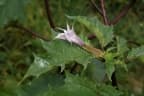
Datura stramonium
Datura stramonium
Safety & Hazards
All members of this genus contain narcotics and are very poisonous, even in small doses[1].
Cultivation Details
A plant originally from the warm areas of the Americas, Datura stramonium has long been cultivated from the warm temperate zone to the tropics. It is intolerant of frost[2]. Succeeds in most moderately good soils but prefers a rich light sandy soil or a calcareous loam, and an open sunny position[3, 4, 1]. The plant often self-sows when well sited[3]. It can become a weed in suitable conditions and is subject to statutory control in some countries[5]. Control is difficult because the plant is resistant to most commonly used herbicides. Contamination of wheat, rye, buckwheat and linseed with seeds of Datura stramonium resulting in poisoning have been reported[2]. The best time for harvesting the leaves is 8 weeks after sowing, because alkaloid content at that time is highest. It is also recommended to harvest the leaves in the early morning or late afternoon[2]. The hyoscyamine/scopolamine ratio in the plant is influenced by the developmental stage reached by the plants. In younger plants scopolamine is the main alkaloid, whereas hyoscyamine mostly becomes the dominant alkaloid when flower development has started. The alkaloids are produced in the roots and transferred to the leaves, flowers and finally the fruits[2]. The highest yields of scopolamine and hyoscyamine from the plant in Algeria were 7.5 kg/ha and 21 kg/ha, respectively. In India 1 - 1.5 t/ha of dry leaves and 500 - 600 kg/ha of seeds have been obtained[2]. Grows well with pumpkins[6]. The whole plant gives off a nauseating stench[7].
Propagation
Sow the seed in individual pots in early spring in a greenhouse[1]. Put 3 or 4 seeds in each pot and thin if necessary to the best plant. The seed usually germinates in 3 - 6 weeks at 15°c. Plant out in late spring or early summer, after the last expected frosts. Especially in areas with hot summers, it is worthwhile trying a sowing outdoors in situ in mid to late spring. Cite as: Temperate Plants Database, Ken Fern. temperate.theferns.info. 2026-02-21. <temperate.theferns.info/plant/Datura+stramonium>
Pollinators
Hawkmoths
References
- [1]The New RHS Dictionary of Gardening. 1992. — Huxley. A. · MacMillan Press · 1992 · ISBN 0-333-47494-5 ↩︎Excellent and very comprehensive, though it contains a number of silly mistakes. Readable yet also very detailed.
- [2]Protabase - Plant Resources of Tropical Africa. — http://www.prota.org ↩︎An excellent on-line database with detailed information on over 3,200 species of useful plants of Africa.
- [3]RHS Dictionary of Plants plus Supplement. 1956 — F. Chittendon. · Oxford University Press · 1951 · ISBN - ↩︎Comprehensive listing of species and how to grow them. Somewhat outdated, it has been replaced in 1992 by a new dictionary (see [ 200 ]).
- [4]A Modern Herbal. — Grieve. · Penguin · 1984 · ISBN 0-14-046-440-9 ↩︎Not so modern (1930's?) but lots of information, mainly temperate plants.
- [5]Encyclopaedia of Herbs and their Uses. — Bown. D. · Dorling Kindersley, London. · 1995 · ISBN 0-7513-020-31 ↩︎A very well presented and informative book on herbs from around the globe. Plenty in it for both the casual reader and the serious student. Just one main quibble is the silly way of having two separate entries for each plant.
- [6]Companion Planting for Successful Gardening. — Riotte. L. · Garden Way, Vermont, USA. · 1978 · ISBN 0-88266-064-0 ↩︎Fairly good.
- [7]Scented Flora of the World. — Genders. R. · Robert Hale. London. · 1994 · ISBN 0-7090-5440-8 ↩︎An excellent, comprehensive book on scented plants giving a few other plant uses and brief cultivation details. There are no illustrations.
- [8]Plants for Man. — Schery. R. W. ↩︎Fairly readable but not very comprehensive. Deals with plants from around the world.
- [9]Encyclopaedia of Medicinal Plants. — Chiej. R. · MacDonald · 1984 · ISBN 0-356-10541-5 ↩︎Covers plants growing in Europe. Also gives other interesting information on the plants. Good photographs.
- [10]Flora of Canada — Livingstone. B. · National Museums of Canada · 1978 · ISBN 0-660-00025-3 ↩︎In 4 volumes, it does not deal with plant uses but gives descriptions and habitats.
- [11]The Herb Book. — Lust. J. · Bantam books · 1983 · ISBN 0-553-23827-2 ↩︎Lots of information tightly crammed into a fairly small book.
- [12]Earth Medicine, Earth Food. — Weiner. M. A. · Ballantine Books · 1980 · ISBN 0-449-90589-6 ↩︎A nice book to read though it is difficult to look up individual plants since the book is divided into separate sections dealing with the different medicinal uses plus a section on edible plants. Common names are used instead of botanical.
- [13]A Field Guide to Medicinal Plants. Eastern and Central N. America. — Foster. S. & Duke. J. A. · Houghton Mifflin Co. · 1990 · ISBN 0395467225 ↩︎A concise book dealing with almost 500 species. A line drawing of each plant is included plus colour photographs of about 100 species. Very good as a field guide, it only gives brief details about the plants medicinal properties.
- [14]Edible and Medicinal Plants. — Launert. E. · Hamlyn · 1981 · ISBN 0-600-37216-2 ↩︎Covers plants in Europe. a drawing of each plant, quite a bit of interesting information.
- [15]Hamlyn Encyclopaedia of Plants. — Triska. Dr. · Hamlyn · 1975 · ISBN 0-600-33545-3 ↩︎Very interesting reading, giving some details of plant uses and quite a lot of folk-lore.
- [16]Dictionary of Economic Plants. — Uphof. J. C. Th. · Weinheim · 1959 · ISBN - ↩︎An excellent and very comprehensive guide but it only gives very short descriptions of the uses without any details of how to utilize the plants. Not for the casual reader.
- [17]The Dictionary of Modern Herbalism. — Mills. S. Y. ↩︎An excellent small herbal.
- [18]Glossary of Indian Medicinal Plants (Including the Supplement). — Chopra. R. N., Nayar. S. L. and Chopra. I. C. · Council of Scientific and Industrial Research, New Delhi. · 1986 · ISBN - ↩︎Very terse details of medicinal uses of plants with a wide range of references and details of research into the plants chemistry. Not for the casual reader.
- [19]Native American Ethnobotany — Moerman. D. · Timber Press. Oregon. · 1998 · ISBN 0-88192-453-9 ↩︎Very comprehensive but terse guide to the native uses of plants. Excellent bibliography, fully referenced to each plant, giving a pathway to further information. Not for the casual reader.
- [20]Tibetan Medicinal Plants — Tsarong. Tsewang. J. · Tibetan Medical Publications, India · 1994 · ISBN 81-900489-0-2 ↩︎A nice little pocket guide to the subject with photographs of 95 species and brief comments on their uses.
- [21]Medicinal Plants of Nepal — Dept. of Medicinal Plants. Nepal. · 1993 · ISBN - ↩︎Terse details of the medicinal properties of Nepalese plants, including cultivated species and a few imported herbs.
- [22]Companion Plants. — Philbrick H. and Gregg R. B. · Watkins · 1979 · ISBN - ↩︎Details of beneficial and antagonistic relationships between neighbouring plants.