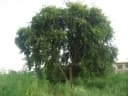
Dalbergia sissoo
Dalbergia sissoo
Safety & Hazards
None known
Cultivation Details
A plant of the tropics and subtropics, it is adapted to a seasonal monsoon climate and a dry season of up to 6 months[1]. It has been planted successfully in regions with 600 - 900 mm annual rainfall, which is too dry for most other timber species. However, for optimal growth more than 1,000 mm of annual rainfall is required[2] and it can succeed in areas with 4,500mm[1]. It is tolerant of some frost, surviving minimum temperatures of -4°c, and can also tolerate temperatures as high as 45°c[1]. Prefers a fertile, loam soil and a position in full sun[3]. Succeeds in poor soils[4], but growth is retarded on badly drained or stony soils[2]. Grows best in an acid to neutral soil[2]. Succeeds in alkaline soils[4]. Older trees are very drought-resistant and can withstand up to 9 dry months and mean annual rainfall of only 400 mm[2]. The tree is very invasive, showing pioneer characteristics, and can become a serious weed, as has been the case in Australia[2]. Seedlings and saplings have a strong taproot with numerous fibrous lateral roots, some of which may later develop into large superficial roots[2]. Young trees may grow fast; under exceptional conditions, they may reach 3.7 metres in 1 year, as much as 11 metres in 5 years and 15 metres in 10 years, but more usually growth rates are 5 metres in 5 years, 10 metres in 10 years and 17 metres (with a mean bole diameter of 25 cm) in 20 years[2]. Trees are often surrounded by numerous root suckers[2]. It is a strong light demander and only vigorous trees attain larger sizes in dense stands, suppressing weaker trees[2]. Trees may start flowering at an early age; in experimental plantations in Tanzania they started to flower 3 years after planting[2]. Trees can be coppiced, although it has been observed that coppiced trees lose vigour after 2 - 3 rotations[2]. Plants are not fire-resistant[2]. This species has a symbiotic relationship with certain soil bacteria, these bacteria form nodules on the roots and fix atmospheric nitrogen. Some of this nitrogen is utilized by the growing plant but some can also be used by other plants growing nearby[5].
Propagation
Seed - usually the seeds are not extracted from the pods, but the pods are broken into 1-seeded pieces[2]. Seeds have no dormancy, and the germination rate may be almost 100% when fresh seed from mature trees is used[2]. Pre-treatment of seeds is not necessary, but soaking in water for 12 - 24 hours accelerates germination[2]. Germination of fresh seed takes 7 - 21 days[2]. Shading is recommended during the hottest hours of the day during the germination period[2]. Like many species within the family Fabaceae, once they have been dried for storage the seeds of this species may benefit from scarification before sowing in order to speed up germination. This can usually be done by pouring a small amount of nearly boiling water on the seeds (being careful not to cook them!) and then soaking them for 12 - 24 hours in warm water. By this time they should have imbibed moisture and swollen - if they have not, then carefully make a nick in the seedcoat (being careful not to damage the embryo) and soak for a further 12 hours before sowing[PFAF]. When stored dry or in a cold store, seeds remain viable for up to 1.5 years[2]. Viability is maintained for 4 years in hermetic storage and 1 - 2 years when stored in airtight containers under dry, cool conditions[1] Root suckers and root and stem cuttings can also be used for propagation. Cite as: Tropical Plants Database, Ken Fern. tropical.theferns.info. 2026-02-20. <tropical.theferns.info/viewtropical.php?id=Dalbergia+sissoo>
Pollinators
Insects, Self
References
- [1]World Agroforesty Centre — http://www.worldagroforestry.org/ ↩︎An excellent online database of a huge range of trees giving very good information on each plant - its uses, ecology, identity, propagation, pests etc.
- [2]Protabase - Plant Resources of Tropical Africa. — http://www.prota.org ↩︎An excellent on-line database with detailed information on over 3,200 species of useful plants of Africa.
- [3]The New RHS Dictionary of Gardening. 1992. — Huxley. A. · MacMillan Press · 1992 · ISBN 0-333-47494-5 ↩︎Excellent and very comprehensive, though it contains a number of silly mistakes. Readable yet also very detailed.
- [4]Tropical and Subtropical Trees - A Worldwide Encyclopaedic Guide. — Barwick. M. · Thames & Hudson, London · 2004 · ISBN 0-500-51181-0 ↩︎A superb book, very concise and well written, giving a wealth of information on 400 or more species including descriptions, habitat, cultivation details and plant uses. A wealth of colour photographs bring each plant vividly to life.
- [5]Nodulation Plants in GRIN Taxonomy — United States Department of Agriculture · http://www.ars-grin.gov/~sbmljw/cgi-bin/taxnodul.pl?language=en ↩︎An online database listing plants that have either positive or negative reports on root and stem nodulation with nitrogen-fixing bacteria.
- [6]Mansfeld's Database of Agricultural and Horticultural Plants — http://mansfeld.ipk-gatersleben.de/pls/htmldb_pgrc/f?p=185:3:4292127278597336 ↩︎Terse details of a huge range of useful plants.
- [7]Ethnobotanical Studies of Useful Trees of District Kotli, Azad Jammu and Kashmir — Muhammad Ajaib & Zaheer-Ud-Din Khan · 2014 · ISBN 2313-206X ↩︎
- [PFAF]Plants for a Future — pfaf.org ↩︎