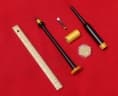
Dalbergia melanoxylon
Dalbergia melanoxylon
Safety & Hazards
None known
Cultivation Details
A plant of low to moderate elevations in the tropics, being found at elevations from sea level to 1,200 metres[1]. It grows in areas where the mean annual temperature is in the range 18 - 35°c and the mean annual rainfall is 700 - 1,200 mm[1]. Succeeds in a variety of soils, from loamy sands to clayey Vertisols (black cotton soils)[1]. This species demands water and light and therefore is common near water and will not regenerate under heavy cover[1]. When introduced into India and Australia, the plant became naturalized[2]. In western Australia it behaved as a very aggressive weed and was quickly eradicated[2]. The species is extremely slow growing. Seven year old trees are only up to 4 metres tall and it takes 70 - 100 years for trees to attain timber size[1, 3]. Trees coppice successfully and also produce root suckers[2]. Trees generally exhibit heavy annual seed production[2]. Mature trees are fire tolerant[1]. This species has a symbiotic relationship with certain soil bacteria, these bacteria form nodules on the roots and fix atmospheric nitrogen. Some of this nitrogen is utilized by the growing plant but some can also be used by other plants growing nearby[4].
Propagation
Seed extracted from pods germinate readily without pre-treatment[1]. They should be kept in the shade for 2 weeks after sowing, but can then be placed in full sun[2]. They germinate 8 - 20 days after sowing, with a germination rate of 50 - 60%[2]. Although pre-treatment of seeds is not necessary, soaking the seeds in water accelerates germination[2]. Experimental work in Tanzania suggests that survival and growth are improved by planting 2-year-old stumps that are 14 cm long, comprising 12 cm of root and 2 cm of shoot[1]. These should be planted in the early or middle part of the rainy season, followed by intensive weeding. Potted seedlings may also be used, but they tend to grow more slowly. When seedlings are raised in pots, frequent root pruning is mandatory[1]. Delayed pruning leads to seedling shock[1]. Like many species within the family Fabaceae, once they have been dried for storage the seeds of this species may benefit from scarification before sowing in order to speed up germination. This can usually be done by pouring a small amount of nearly boiling water on the seeds (being careful not to cook them!) and then soaking them for 12 - 24 hours in warm water. By this time they should have imbibed moisture and swollen - if they have not, then carefully make a nick in the seedcoat (being careful not to damage the embryo) and soak for a further 12 hours before sowing[PFAF]. Seed storage behaviour is orthodox; viability can be maintained for several years in hermetic storage at 3°c with 9 - 12% mc[1]. Softwood cuttings of many species, especially if taken from younger plants, will root in a well-drained, sandy medium in a closed case with bottom heat[5]. Cite as: Tropical Plants Database, Ken Fern. tropical.theferns.info. 2026-02-20. <tropical.theferns.info/viewtropical.php?id=Dalbergia+melanoxylon>
Pollinators
Bees
References
- [1]World Agroforesty Centre — http://www.worldagroforestry.org/ ↩︎An excellent online database of a huge range of trees giving very good information on each plant - its uses, ecology, identity, propagation, pests etc.
- [2]Protabase - Plant Resources of Tropical Africa. — http://www.prota.org ↩︎An excellent on-line database with detailed information on over 3,200 species of useful plants of Africa.
- [3]Trees and Shrubs of the Sahel. Their Characteristics and Uses. — von Maydell H. · Deutsche Gesellschaft fur Technische Zusammenarbeit; Germany · 1990 · ISBN 3-8236-1198-4 ↩︎A well-researched book, usually with more than one photograph of each species and good information on the plant and its uses.
- [4]Nodulation Plants in GRIN Taxonomy — United States Department of Agriculture · http://www.ars-grin.gov/~sbmljw/cgi-bin/taxnodul.pl?language=en ↩︎An online database listing plants that have either positive or negative reports on root and stem nodulation with nitrogen-fixing bacteria.
- [5]The New RHS Dictionary of Gardening. 1992. — Huxley. A. · MacMillan Press · 1992 · ISBN 0-333-47494-5 ↩︎Excellent and very comprehensive, though it contains a number of silly mistakes. Readable yet also very detailed.
- [6]IUCN Red List of Threatened Species — http://www.iucnredlist.org/ ↩︎A list of plants under threat and facing possible extinction, usually with brief details of the threats and information on habitat.
- [7]The Hongmu Challenge; A briefing for the 66th meeting of the CITES Standing Committee, January 2016 — Environmental Investigation Agency; London · 2016 · http://www.eia-global.org ↩︎Lists the 33 species used in making Hungmu furniture and the degree of over-exploitation plus recommendations for protecting them.
- [PFAF]Plants for a Future — pfaf.org ↩︎