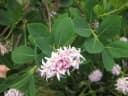
Dais cotinifolia
Dais cotinifolia
Safety & Hazards
None known
Cultivation Details
A plant of the subtropics and higher elevations in the tropics. Young trees less than three years old require some protection from frost, but older trees are more tolerant[1]. Requires a sunny position in a well-drained soil[2, 1]. Established plants are fairly drought resistant[1]. Plants often self-sow when in cultivation[3]. A fast-growing plant; in South Africa trees reach their full height within 4 - 5 years, commencing flowering in their second year of growth[3, 1]. Flowers are produced on the previous year’s growth[1].
Propagation
Seed - sow in a shady position in a nursery seedbed or in seed trays[3]. Prick the seedlings out into individual containers as soon as they are large enough to handle[3]. Cuttings of half-ripe wood. Cite as: Tropical Plants Database, Ken Fern. tropical.theferns.info. 2026-02-20. <tropical.theferns.info/viewtropical.php?id=Dais+cotinifolia>
Pollinators
Insects
References
- [1]Protabase - Plant Resources of Tropical Africa. — http://www.prota.org ↩︎An excellent on-line database with detailed information on over 3,200 species of useful plants of Africa.
- [2]The New RHS Dictionary of Gardening. 1992. — Huxley. A. · MacMillan Press · 1992 · ISBN 0-333-47494-5 ↩︎Excellent and very comprehensive, though it contains a number of silly mistakes. Readable yet also very detailed.
- [3]PlantZAfrica.com — http://www.plantzafrica.com ↩︎An excellent site giving detailed descriptions and uses of many S. African plants.
- [4]Useful Fiber Plants of the World — Dodge C.R. · USDA; Washington. · 1897 · http://www.biodiversitylibrary.org/ ↩︎A rather dated, but very comprehensive catalogue of fibre plants from around the world. The book can be downloaded from the Internet.
- [5]Flora Capensis — Hiern. W.P.; Brown N.E. · 1909 · http://www.aluka.org/action/doBrowse?sa=1&st=662543&execbr=&sls= ↩︎Rather dated, and many of the botanical names have been changed since it was written, but contains a wealth of information about plants of southern Africa. It can be downloaded or viewed online.