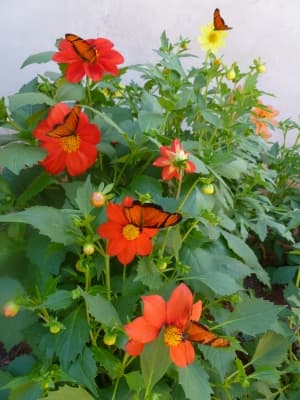
Dahlia pinnata
Dahlia pinnata
Safety & Hazards
We have no specific information for this species, but the leaves and tubers of several Dahlia species are known to contain phototoxic polyacetylene compounds that can cause skin irritation following repeated handling of the tubers and contact with leaves and light[1].
Cultivation Details
Most Dahlia species in Mexico grow at moderate to higher elevations, typically above 2,100 metres in southern Mexico, where there can be rapid changes in temperature, but no frosts[2]. The dahlia’s home area in the volcanic highlands of southern Mexico is hot and dry during the winter months but the rainy season during summer is characterized by afternoon thunderstorms. Also, dahlias are adapted to grow while being bathed in dew from the low hanging clouds[2]. The top growth of Dahlia pinnata is very frost-tender, though the tubers are somewhat hardier and can tolerate temperatures down to about -5°c[3]. An easily grown plant so long as the soil does not dry out[3]. It requires a deep rich soil and a sunny position[4], disliking shade[5]. Dahlia species in the wild are generally found on well-drained hillsides, rough banks and cliffs. The soil is typically a soft, porous and sandy loam with a gravelly subsoil which is often volcanic and mildly acidic[2]. Dahlia tubers are worth some experimentation as a root crop either for food or for sugar production since their root sugar content is quite respectable even without artificial selection. For example, up to 15 sweet potato-sized tubers, containing as much as 13% fruit sugar, can be produced by a single plant in one season under optimum conditions. This high sugar content, even among wild dahlias, compares favorably with sugar beets, even though sugar beets have been scientifically selected so that their sugar content has been increased from 7% to 20%. Such scientific breeding could lead to a similar increase in the sugar content of dahlias if they become recognized as a worthwhile agricultural plant[2]. In areas where winters are wet, or where temperatures are likely to fall to -5°c or lower, it is best to harvest the tubers after the foliage is killed off by frost and then store them in a cool but frost-free place over the winter, planting them out again in the middle to late spring[5].
Propagation
Seed - sow late winter to mid spring in a greenhouse. The seed usually germinates in 1 - 3 weeks at 20°c[4]. When they are large enough to handle, prick the seedlings out into individual pots and grow them on in the greenhouse for at least their first winter. Plant them out into their permanent positions in late spring or early summer, after the last expected frosts. Cuttings of young shoots in early spring. The tubers are usually brought into the greenhouse in late winter in order to encourage early growth and young basal shoots are removed as soon as they are large enough[5]. Division. The roots are usually harvested in the autumn. These can be divided into individual tubers when planting out in the spring. Each portion should have a growing point[5]. Cite as: Temperate Plants Database, Ken Fern. temperate.theferns.info. 2026-02-21. <temperate.theferns.info/plant/Dahlia+pinnata>
Pollinators
Insects
References
- [1]Poisonous Plants of North Carolina — http://www.ces.ncsu.edu/depts/hort/consumer/poison/poison.htm ↩︎An excellent concise but comprehensive guide to toxic plants that grow in N. Carolina. It lists even those plants that are of very low toxicity, including several well-known food plants such as carrots and potatoes.
- [2]The Medicinal and Nutritional Properties of Dahlia spp. — Whitley G.R. · 1985 ↩︎
- [3]Conservatory and Indoor Plants Volumes 1 & 2 — Phillips. R. & Rix. M. · Pan Books, London. · 1998 · ISBN 0-330-37376-5 ↩︎Excellent photos of over 1,100 species and cultivars with habits and cultivation details plus a few plant uses. Many species are too tender for outdoors in Britain though there are many that can be grown outside.
- [4]Growing from Seed. Volume 4. — Bird. R. (Editor) · Thompson and Morgan. · 1990 · ISBN - ↩︎Very readable magazine with lots of information on propagation. A good article on Yuccas, one on Sagebrush (Artemesia spp) and another on Chaerophyllum bulbosum.
- [5]The New RHS Dictionary of Gardening. 1992. — Huxley. A. · MacMillan Press · 1992 · ISBN 0-333-47494-5 ↩︎Excellent and very comprehensive, though it contains a number of silly mistakes. Readable yet also very detailed.
- [6]A Modern Herbal. — Grieve. · Penguin · 1984 · ISBN 0-14-046-440-9 ↩︎Not so modern (1930's?) but lots of information, mainly temperate plants.
- [7]Meet Flora Mexicana. — Pesman. M. W. · Dale S. King. Arizona. · 1962 · ISBN - ↩︎Very readable flora but rather lacking botanically. A few notes on useful plants.
- [8]Sturtevant's Edible Plants of the World. — Hedrick. U. P. · Dover Publications · 1972 · ISBN 0-486-20459-6 ↩︎Lots of entries, quite a lot of information in most entries and references.
- [9]Plants for Human Consumption. — Kunkel. G. · Koeltz Scientific Books · 1984 · ISBN 3874292169 ↩︎An excellent book for the dedicated. A comprehensive listing of Latin names with a brief list of edible parts.
- [10]Cornucopia II — Facciola. S. · Kampong Publications, California. · 1998 · ISBN 0-9628087-2-5 ↩︎The second edition of an excellent guide to the edible uses of plants, though it does not give any details of cultivation etc.
- [11]Cornucopia - A Source Book of Edible Plants. — Facciola. S. · Kampong Publications · 1990 · ISBN 0-9628087-0-9 ↩︎Excellent. Contains a very wide range of conventional and unconventional food plants (including tropical) and where they can be obtained (mainly N. American nurseries but also research institutes and a lot of other nurseries from around the world.
- [12]A Dictionary of Plants Used by Man. — Usher. G. · Constable · 1974 · ISBN 0094579202 ↩︎Forget the sexist title, this is one of the best books on the subject. Lists a very extensive range of useful plants from around the world with very brief details of the uses. Not for the casual reader.
- [13]Alternative Enterprises for Agriculture in the UK. — Carruthers. S. P. (Editor) · Centre for Agricultural Strategy, Univ. of Reading · 1986 · ISBN 0704909820 ↩︎Some suggested alternative commercial crops for Britain. Readable. Produced by a University study group.
- [14]Economic Botany. — Hill. A. F. · The Maple Press · 1952 · ISBN - ↩︎Not very comprehensive, but it is quite readable and goes into some detail about the plants it does cover.
- [15]Nature's Colors - Dyes from Plants. — Grae. I. · MacMillan Publishing Co. New York. · 1974 · ISBN 0-02-544950-8 ↩︎A very good and readable book on dyeing.
- [16]A Weavers Garden — Buchanan. R. · McGraw-Hill Contemporary · 1987 · ISBN 0934026289 ↩︎Covers all aspects of growing your own clothes, from fibre plants to dyes.
- [PFAF]Plants for a Future — pfaf.org ↩︎