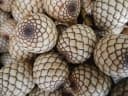
Daemonorops draco
Daemonorops draco
Safety & Hazards
None known
Cultivation Details
A plant of moist lowland tropical areas. Most species in this genus are more or less vigorous climbing plants in rainforests. In general, they are likely to grow best with their roots in the shade but with enough gap in the canopy to encourage their stems to grow up towards the light. They are also likely to grow best in a humus-rich soil[PFAF]. This species is one of several that supply a red resin from their stem. This resin, often known as 'Dragon's Blood' is often used as an external application to treat a range of skin problems and injuries[1]. Dragon's Blood can be obtained from several species in this genus, as well as from three other distinct genera - Dracaena species, Croton species and Pterocarpus species[1] Harvesting is done by climbing a tree near the plant and hand picking the fruits. Old fruits contain more resin[2]. A clump of the plant produces around 50 kilos of dragon blood fruits[2]. A dioecious species, both male and female forms need to be grown if fruit and seed are required[3].
Propagation
Seed - Cite as: Tropical Plants Database, Ken Fern. tropical.theferns.info. 2026-02-20. <tropical.theferns.info/viewtropical.php?id=Daemonorops+draco>
Pollinators
Data unavailable
References
- [1]A Systematic Review of the Botanical, Phytochemical and Pharmacological Profile of Dracaena cochinchinensis, a Plant — Jia-Yi Fan et al · 2014 · http://10.3390/molecules190710650 · ISBN 1420-3049 ↩︎
- [2]Speciality Rattans of the ASEAN — A. C. Baja-Lapis · National Herbarium, Nederland. · 2009 · http://www.ingentaconnect.com/content/nhn/blumea ↩︎A description of the uses and agricultural practices for 11 selected species of rattan.
- [3]Annals of the Royal Botanic Garden Calcutta. Vol. 12, Pt. 1 — Beccari O. · Bengal Secretariat Press; Calcutta. · 1911 · http://www.biodiversitylibrary.org ↩︎A monograph of the genus Daemonorops. It can be downloaded from the Internet.
- [4]Plant Resources of Southeast Asia — http://proseanet.org/ ↩︎Lots of information on the uses of the plants of SE Asia.
- [5]Cornucopia II — Facciola. S. · Kampong Publications, California. · 1998 · ISBN 0-9628087-2-5 ↩︎The second edition of an excellent guide to the edible uses of plants, though it does not give any details of cultivation etc.
- [6]Dictionary of Economic Plants. — Uphof. J. C. Th. · Weinheim · 1959 · ISBN - ↩︎An excellent and very comprehensive guide but it only gives very short descriptions of the uses without any details of how to utilize the plants. Not for the casual reader.
- [7]Annals of the Royal Botanical Garden, Calcutta Vol. XI and Appendix — Dr Odoardo Beccari · Royal Botanic Garden, Calcutta · 1908 ↩︎This volume of the journal is dedicated entirely to a monograph of the genus Calamus, which remains an important treatment over 100 years later.
- [PFAF]Plants for a Future — pfaf.org ↩︎