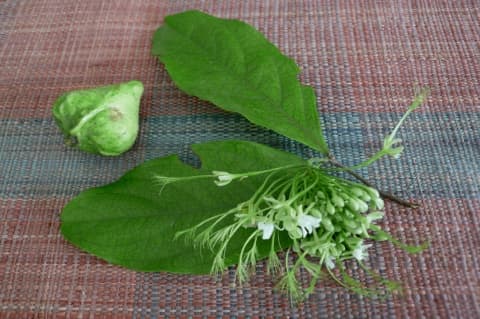
Dactyladenia barteri
Dactyladenia barteri
Safety & Hazards
None known
Cultivation Details
A plant of the moist, lowland tropics, being found at elevations below 300 metres[1]. It grows in areas where the mean annual temperature is in the range 20 - 34°c, and the mean annual rainfall is 750 - 1,500 mm[1]. Well adapted to leached, acid and infertile (ultisols) soils, the plant can also survive occasional flooding[1]. Established trees coppice well, even after pollarding or burning, and are fire resistant[2, 1]. Planted at 4 metres x 4metres, this species can produce 6 tonnes per hectare dry prunings, 4 tonnes of twigs and 9 tonnes of wood within 8 months[1]. It has been suggested that Dactyladenia lehmbachii and Dactyladenia pallescens, which flower in the same period, may cross-pollinate with this species[3].
Propagation
Seed - germinates readily[1]. Direct sowing is possible but seedlings survive better when raised in nursery bags before planting out[1]. Seed germinates readily and can be stored for up to 6 months at 15°c when treated with copper sulphate[1]. Occasionally, stakes are used as cuttings in live fence systems[1]. Juvenile stem cuttings will also root quickly at the peak of the rainy season[3]. Cite as: Tropical Plants Database, Ken Fern. tropical.theferns.info. 2026-02-20. <tropical.theferns.info/viewtropical.php?id=Dactyladenia+barteri>
Pollinators
Red ants, Bees, Wasps
References
- [1]World Agroforesty Centre — http://www.worldagroforestry.org/ ↩︎An excellent online database of a huge range of trees giving very good information on each plant - its uses, ecology, identity, propagation, pests etc.
- [2]Plants in British Columbian Indian Technology. — Turner. N. J. · British Columbia Provincial Museum · 1979 · ISBN 0-7718-8117-7 ↩︎Excellent and readable guide.
- [3]Protabase - Plant Resources of Tropical Africa. — http://www.prota.org ↩︎An excellent on-line database with detailed information on over 3,200 species of useful plants of Africa.