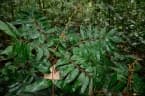
Dacryodes buettneri
Dacryodes buettneri
Safety & Hazards
None known
Cultivation Details
A plant of the moist, lowland tropics where it can be found at elevations up to 700 metres. It is found in areas where the mean annual rainfall is within the range 2,000 - 3,000mm[1]. Young seedlings can tolerate quite dense shade, but most will not survive very long unless more light becomes available. Older plants prefer a sunny position[1]. Prefers well-drained soils[1]. Found mainly on clayey soils in the wild[1]. In mixed plantings with other species in Ekouk (Gabon), the survival rate was 30 - 70% after 3 years, without much mortality afterwards. When 10 years old, the trees had an average bole diameter of 8 - 9cm. Although they were in good health, all trees had a sinuous bole. In Lopé (Gabon) the annual increase in bole diameter was 4.5mm in dense forest and 6.8mm in more open Marantaceae forest[1]. The trees fruit massively approximately every 3 years; fruit abortion is common[1]. A dioecious species, both male and female forms need to be grown if fruit and seed are required[1].
Propagation
Seed - best sown as soon as it is ripe. Germination takes 30 - 37 days[1]. The seeds can germinate in forest undergrowth and tolerate quite low light intensities. The seeds may form dense mats below mother trees, but many of them disappear rapidly. Some seedlings may persist in forest undergrowth for several years, but more light seems necessary for subsequent growth[1]. Cite as: Tropical Plants Database, Ken Fern. tropical.theferns.info. 2026-02-20. <tropical.theferns.info/viewtropical.php?id=Dacryodes+buettneri>
Pollinators
Insects
References
- [1]Protabase - Plant Resources of Tropical Africa. — http://www.prota.org ↩︎An excellent on-line database with detailed information on over 3,200 species of useful plants of Africa.
- [2]African Flowering Plants Database — Conservatoire et Jardin Botaniques. · http://www.ville-ge.ch/musinfo/bd/cjb/africa/recherche.php ↩︎Contains information on over 150,000 plant names (including synonyms) giving a description and habitat, plus a distribution map.