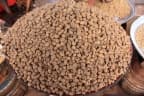
Cyperus esculentus
Cyperus esculentus
Safety & Hazards
None known
Cultivation Details
Cyperus esculentus is native to the subtropical and tropical zones, extending into the temperate zone in some regions, especially N. America. In the tropics it is found at elevations up to 2,000 metres, but is found at much lower elevations in cooler climates. It grows best in areas where annual daytime temperatures are within the range 14 - 26°c, but can tolerate 4 - 30°c[1]. Top growth can be killed by temperatures of -2°c or lower, but the tubers are able to overwinter in the ground even though the soil may freeze[1]. The tubers are hardy to about -15°c[2]. The plant prefers a mean annual rainfall in the range 500 - 1,000mm, but tolerates 300 - 1,700mm[1]. Succeeds in full sun and also in light shade[1]. Prefers a moist sandy loam[3, 4], but can succeed in most soils[1]. Plants can tolerate occasional inundation of the soil[1]. Prefers a Ph in the range 5 - 7, tolerating 4.5 - 7.5[1]. There can be problems growing this species in cooler climates. Once the tubers come into growth then they normally grow vigorously, but the difficulty can be in getting them to come into growth. We harvest the tubers in the autumn and store them in moist sand, replanting them in the spring. However, they rarely come into new growth until mid to late summer which gives them too short a growing season to produce much of a crop[PFAF]. We need to find a satisfactory way of storing the tubers and exciting them back into growth[PFAF]. Mature tubers can be harvested 90 - 120 days from planting[1]. There is a cultivated variety, var. sativus, that produces larger tubers[5]. The tubers are often formed a metre or more away from the plant, especially if it is growing in a heavy clay soil[6]. The tubers are extremely attractive to mice and require protection from them in the winter[PFAF].
Propagation
Seed - surface sow in the spring and keep the compost moist[7]. The seed usually germinates in 2 - 6 weeks at 18°c[7]. Prick out the seedlings into individual pots as soon as they are large enough to handle. Grow on for their first winter in a greenhouse and plant them out in late spring after the last expected frosts. Division in spring or autumn. This is more a matter of harvesting the tubers and replanting them. If this is done in the autumn, then it is best to store the tubers in a cool frost-free place overwinter and plant them out in the spring. Cite as: Temperate Plants Database, Ken Fern. temperate.theferns.info. 2026-02-21. <temperate.theferns.info/plant/Cyperus+esculentus>
Pollinators
Wind
References
- [1]Ecocrop — http://ecocrop.fao.org/ecocrop/srv/en/home ↩︎Basic information on a wide range of useful plants, plus details of environmental needs where available.
- [2]The New RHS Dictionary of Gardening. 1992. — Huxley. A. · MacMillan Press · 1992 · ISBN 0-333-47494-5 ↩︎Excellent and very comprehensive, though it contains a number of silly mistakes. Readable yet also very detailed.
- [3]Edible and Useful Wild Plants of the United States and Canada. — Saunders. C. F. · Dover Publications · 1976 · ISBN 0-486-23310-3 ↩︎Useful wild plants of America. A pocket guide.
- [4]The Book of Edible Nuts. — Rosengarten. jnr. F. · Walker & Co. · 1984 · ISBN 0802707699 ↩︎A very readable and comprehensive guide. Well illustrated.
- [5]Flora Europaea — ? · Cambridge University Press · 1964 · ISBN - ↩︎An immense work in 6 volumes (including the index). The standard reference flora for Europe, it is very terse though and with very little extra information. Not for the casual reader.
- [6]Wild Food Plants of Indiana. — McPherson. A. and S. · Indiana University Press · 1977 · ISBN 0-253-28925-4 ↩︎A nice pocket guide to this region of America.
- [7]Growing from Seed. Volume 4. — Bird. R. (Editor) · Thompson and Morgan. · 1990 · ISBN - ↩︎Very readable magazine with lots of information on propagation. A good article on Yuccas, one on Sagebrush (Artemesia spp) and another on Chaerophyllum bulbosum.
- [8]Flora of China — Missouri Botanical Garden Press; St. Louis. · 1994 · http://flora.huh.harvard.edu/china/ ↩︎An excellent, comprehensive resource in 25 volumes. In addition to the botanical information the flora also gives basic information on habitat and some uses. An on-line version is also available.
- [9]IUCN Red List of Threatened Species — http://www.iucnredlist.org/ ↩︎A list of plants under threat and facing possible extinction, usually with brief details of the threats and information on habitat.
- [10]Sturtevant's Edible Plants of the World. — Hedrick. U. P. · Dover Publications · 1972 · ISBN 0-486-20459-6 ↩︎Lots of entries, quite a lot of information in most entries and references.
- [11]A Modern Herbal. — Grieve. · Penguin · 1984 · ISBN 0-14-046-440-9 ↩︎Not so modern (1930's?) but lots of information, mainly temperate plants.
- [12]Eat the Weeds. — Harris. B. C. · Pivot Health · 1973 · ISBN - ↩︎Interesting reading.
- [13]A Field Guide to N. American Edible Wild Plants. — Elias. T. and Dykeman. P. · Van Nostrand Reinhold · 1982 · ISBN 0442222009 ↩︎Very readable.
- [14]Edible Native Plants of the Rocky Mountains. — Harrington. H. D. · University of New Mexico Press · 1967 · ISBN 0-8623-0343-9 ↩︎A superb book. Very readable, it gives the results of the authors experiments with native edible plants.
- [15]Cornucopia - A Source Book of Edible Plants. — Facciola. S. · Kampong Publications · 1990 · ISBN 0-9628087-0-9 ↩︎Excellent. Contains a very wide range of conventional and unconventional food plants (including tropical) and where they can be obtained (mainly N. American nurseries but also research institutes and a lot of other nurseries from around the world.
- [16]RHS Dictionary of Plants plus Supplement. 1956 — F. Chittendon. · Oxford University Press · 1951 · ISBN - ↩︎Comprehensive listing of species and how to grow them. Somewhat outdated, it has been replaced in 1992 by a new dictionary (see [ 200 ]).
- [17]A Dictionary of Plants Used by Man. — Usher. G. · Constable · 1974 · ISBN 0094579202 ↩︎Forget the sexist title, this is one of the best books on the subject. Lists a very extensive range of useful plants from around the world with very brief details of the uses. Not for the casual reader.
- [18]The Vegetable Garden. — Vilmorin. A. · Ten Speed Press · ISBN 0-89815-041-8 ↩︎A reprint of a nineteenth century classic, giving details of vegetable varieties. Not really that informative though.
- [19]The Encyclopedia of Medicinal Plants — Chevallier. A. · Dorling Kindersley. London · 1996 · ISBN 9-780751-303148 ↩︎An excellent guide to over 500 of the more well known medicinal herbs from around the world.
- [20]Glossary of Indian Medicinal Plants (Including the Supplement). — Chopra. R. N., Nayar. S. L. and Chopra. I. C. · Council of Scientific and Industrial Research, New Delhi. · 1986 · ISBN - ↩︎Very terse details of medicinal uses of plants with a wide range of references and details of research into the plants chemistry. Not for the casual reader.
- [21]Plants for Man. — Schery. R. W. ↩︎Fairly readable but not very comprehensive. Deals with plants from around the world.
- [22]Flora of the USSR. — Komarov. V. L. · Israel Program for Scientific Translation · 1968 · http://www.biodiversitylibrary.org · ISBN - ↩︎An immense (25 or more large volumes) and not yet completed translation of the Russian flora. Full of information on plant uses and habitats but heavy going for casual readers. It can be downloaded from the Internet.
- [23]Alternative Enterprises for Agriculture in the UK. — Carruthers. S. P. (Editor) · Centre for Agricultural Strategy, Univ. of Reading · 1986 · ISBN 0704909820 ↩︎Some suggested alternative commercial crops for Britain. Readable. Produced by a University study group.
- [24]CosIng — http://ec.europa.eu/growth/tools-databases/cosing/ ↩︎CosIng is the European Commission database for information on cosmetic substances and ingredients.
- [25]Chinese Materia Medica. — Stuart. Rev. G. A. · Taipei. Southern Materials Centre · 1911 · ISBN - ↩︎A translation of an ancient Chinese herbal. Fascinating.
- [PFAF]Plants for a Future — pfaf.org ↩︎