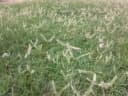
Cynodon dactylon
Cynodon dactylon
Safety & Hazards
Bermuda grass is reported to be photosensitizing in animals[1]. Under certain environmental conditions the plant can produce hydrocyanic acid and so is potentially toxic to livestck[2]. The plant is also said to cause contact dermatitis and, with its high production of pollen, can be a major cause of hayfever[1, 2].
Cultivation Details
Originally from tropical Africa and Asia, Bermuda grass has been introduced to all tropical and subtropical regions of the world and has been found to survive as far north as at 50°N in Europe and at elevations up to 4,000 metres in the Himalayas[3]. It grows best where mean daily temperatures are above 24°c. Temperatures of -2 to -3°c usually kill the leaves and stems back to the ground, but the rhizomes survive these temperatures and regrowth is rapid when the weather warms up[3]. Plants can survive short periods with temperatures falling to about -10°c[4]. Bermuda grass is reported to tolerate an annual precipitation of 90 - 4,290mm[1], though it is generally found in the tropics in areas where the mean annual rainfall is in the range 600 - 1,800mm[5]. Prefers a warm sunny position in a well-drained soil[4]. The plant can grow in very diverse conditions of soil and moisture, withstanding drought well and also tending to eliminate other plants[1]. It spreads quite rapidly, rooting at the nodes, becoming difficult to eradicate and can be a serious weed in cultivated land[1]. Tolerant of a broad soil pH range from 4.3 - 8.4, but grows best with a soil pH above 5.5[1, 3]. Reported from the Hindustani Centre of Diversity, Bermuda grass, or cultivars thereof, is reported to tolerate alkali soil conditions, disease, drought, frost, grazing, herbicide, heavy metal, heavy soil, insects, laterite, nematodes, peat, poor soil, salt, sand, atmospheric pollution, ultraviolet, virus, water-logging and weeds[1]. It is unproductive in poor dry soils and is best adapted to relatively fertile, well-drained soils with a pH of 6.0-7.0, in humid areas. Plants withstand long periods of drought, as they produce little growth in dry weather[1]. Plants vary greatly in habit according to soil and climate, and occur in several natural strains which differ widely in size, colour (bright, yellow-green to dull blue-green), texture of stars and leaves, size of spikes, and grazing value. Most varieties are poor seeders and are propagated by their creeping stem. Bermudagrass can form dense cover in almost pure stands, practically anywhere. Abundant as a weed along roadsides, in lawns, on sandy wastes, along sand dunes, and readily takes possession of any uncultivated area[1].
Propagation
Seed - sow spring in a greenhouse and only just cover the seed. Germination should take place within 2 weeks. Prick out the seedlings into individual pots when they are large enough to handle, and grow them on in the greenhouse for their first winter. Plant out into their permanent positions in late spring. There are almost 4,000,000 seeds per kilo[1]. Division in late spring. Very simple, plants can be propagated easily from rooted sideshoots, establishing quickly when planted straight into the soil[1]. Cite as: Temperate Plants Database, Ken Fern. temperate.theferns.info. 2026-02-21. <temperate.theferns.info/plant/Cynodon+dactylon>
Pollinators
Wind
References
- [1]Handbook of Energy Crops — Duke. J. · - · 1983 · https://hort.purdue.edu/newcrop/duke_energy/dukeindex.html · ISBN - ↩︎Published only on the Internet, excellent information on a wide range of both temperate and tropical plants.
- [2]Illustrated Flora of North Central Texas — Diggs, Jnr. G.M.; Lipscomb. B. L. & O'Kennon. R. J · Botanical Research Institute, Texas. · 1999 · http://artemis.austincollege.edu/acad/bio/gdiggs/NCTXpdf.htm · ISBN 1-889878-01-4 ↩︎An excellent flora, which is also available on-line.
- [3]Plant Resources of Southeast Asia — http://proseanet.org/ ↩︎Lots of information on the uses of the plants of SE Asia.
- [4]The New RHS Dictionary of Gardening. 1992. — Huxley. A. · MacMillan Press · 1992 · ISBN 0-333-47494-5 ↩︎Excellent and very comprehensive, though it contains a number of silly mistakes. Readable yet also very detailed.
- [5]Global Invasive Species Database — http://www.issg.org/database/welcome/ ↩︎Very detailed information on almost 400 species (with more being added) of plants that have become weeds in areas outside their native range.
- [6]Flowers of India — http://www.flowersofindia.net/ ↩︎A wed site of native Indian plants, plus cultivated and naturalized species. It has good quality photos and terse details on more than 3,000 species and cultivars.
- [7]Pacific Island Ecosystems at Risk — http://www.hear.org/pier/scientificnames/index.html ↩︎A very good website detailing weed species that have been introduced into the Pacific Islands.
- [8]Flora of the British Isles. — Clapham, Tutin and Warburg. · Cambridge University Press · 1962 · ISBN - ↩︎A very comprehensive flora, the standard reference book but it has no pictures.
- [9]The Useful Plants of the Island of Guam — Safford W.E. · Smithsonian Institute; Washington. · 1905 · http://www.biodiversitylibrary.org/ ↩︎A very comprehensive, if rather dated, guide to the plants of Guam. It can be downloaded from the Internet.
- [10]Medicinal Plants of the Guianas — DeFilipps, R. A.; Maina, S. L.; & Crepin, J. · Smithsonian Museum · http://botany.si.edu/bdg/medicinal/index.html ↩︎A down-loadable PDF document of a book in pre-publication awaiting illustration. An excellent, if rather terse, guide to the traditional medicinal uses of the plants of the region
- [11]Glossary of Indian Medicinal Plants (Including the Supplement). — Chopra. R. N., Nayar. S. L. and Chopra. I. C. · Council of Scientific and Industrial Research, New Delhi. · 1986 · ISBN - ↩︎Very terse details of medicinal uses of plants with a wide range of references and details of research into the plants chemistry. Not for the casual reader.
- [12]Medicinal Plants of Nepal — Dept. of Medicinal Plants. Nepal. · 1993 · ISBN - ↩︎Terse details of the medicinal properties of Nepalese plants, including cultivated species and a few imported herbs.
- [13]Plants and People of Nepal — Manandhar. N. P. · Timber Press. Oregon. · 2002 · ISBN 0-88192-527-6 ↩︎Excellent book, covering over 1,500 species of useful plants from Nepal together with information on the geography and peoples of Nepal. Good descriptions of the plants with terse notes on their uses.
- [14]New Crops FactSheets — Purdue University · http://www.hort.purdue.edu/newcrop/default.html ↩︎A website dedicated to giving information on potential new agricultural crops.