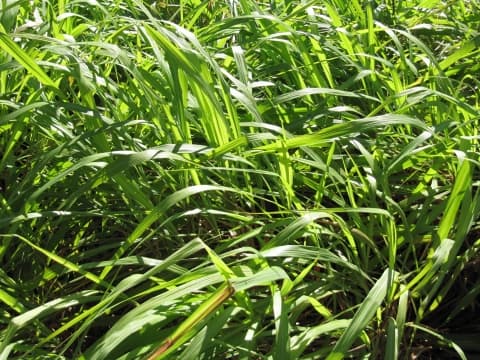
Cymbopogon winterianus
Cymbopogon winterianus
Safety & Hazards
None known
Cultivation Details
A plant of the moist, lowland tropics, where it is found at elevations up to 1,000 metres. It grows best in areas where annual daytime temperatures are within the range 22 - 30°c, but can tolerate 16 - 36°c[1]. It prefers a mean annual rainfall in the range 1,500 - 2,200mm, but tolerates 1,000 - 4,100mm[1]. Grows best in a dry to moist, well-drained soil and a position in full sun[2]. Some forms of the plant can tolerate water-logging[3]. Prefers a pH in the range 5 - 6, tolerating 4.3 - 8[1]. The first cutting is usually taken 180 - 270 days after planting, subsequent harvesting is done every 90 - 120 days and the crop last for 4 - 5 years, as yields steadily decline[1]. Average yields of essential oil is usually between 45 - 110 kg/ha[1]. Cultivars have been developed in India with yields of up to 385 kilos per hectare[3].
Propagation
Seed - this is often not formed. Seedlings should not be used, other than in breeding programmes, since they are likely to be inferior to the parent plant in essential oil production. Division of the clumps is very easy, with the divisions rooting quickly and forming new stems within a month[4]. Cite as: Tropical Plants Database, Ken Fern. tropical.theferns.info. 2026-02-20. <tropical.theferns.info/viewtropical.php?id=Cymbopogon+winterianus>
Pollinators
Data unavailable
References
- [1]Ecocrop — http://ecocrop.fao.org/ecocrop/srv/en/home ↩︎Basic information on a wide range of useful plants, plus details of environmental needs where available.
- [2]The New RHS Dictionary of Gardening. 1992. — Huxley. A. · MacMillan Press · 1992 · ISBN 0-333-47494-5 ↩︎Excellent and very comprehensive, though it contains a number of silly mistakes. Readable yet also very detailed.
- [3]Promising Cultivars of Medicinal and Aromatic Crops and their Large Scale Propagation — S. K. Kothari; K. P. Sastry; C. P. Singh; D. K. Rajput and B · A.P. Medicinal & Aromatic Plants Board; Hyderabad, India · 2006 ↩︎A Conference Paper, said to be from January 2006, but no date given on the Paper.
- [4]Plant Resources of Southeast Asia — http://proseanet.org/ ↩︎Lots of information on the uses of the plants of SE Asia.
- [PFAF]Plants for a Future — pfaf.org ↩︎