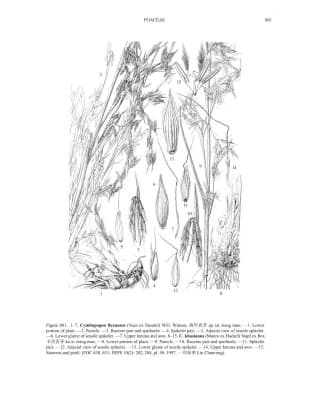
Cymbopogon flexuosus
Cymbopogon flexuosus
Safety & Hazards
None known
Cultivation Details
A plant of the moist to wet lowland tropics and subtropics. It grows best in areas where annual daytime temperatures are within the range 22 - 30°c, but can tolerate 13 - 34°c[1]. It can be killed by temperatures of 5°c or lower[1]. It prefers a mean annual rainfall in the range 1,500 - 3,000mm, but tolerates 700 - 4,100mm[1]. In areas with a cool season, the plant can die back above ground and perennate through its rhizomes; resuming growth with the return of the warm weather[2]. Prefers a moisture-retentive soil in full sun[3]. Requires a well-drained soil, preferring a fertile, sandy loam[2]. Plants are tolerant of moderately saline soils[4]. Prefers a pH in the range 5 - 5.5, tolerating 4.5 - 6[1]. A first harvest can be taken at about 90 - 120 days after planting out, and thereafter every 40 - 55 days for about 6 years[1]. Average yield is about 20 - 40 kg oil/ha/year[1]. Yield of foliage is higher on fertile heavy soils, but under these conditions the oil usually has a lower citral content[1]. Annual yields of selected cultivars can be 250 kilos per hectare[5]. In commercial production only selected plants are allowed to flower for seed production because profuse flowering prior to cutting substantially reduces oil yield[2]. Lemongrass should be stored separately from other foods, or should be well wrapped, otherwise its strong scent will taint the other foods[3].
Propagation
Seed - surface sow or only just cover, sowing the seeds in a nursery seedbed. Prick out the seedlings into individual pots at the 3 - 4 leaf stage and grow on until large enough to plant out. Seed can also be sown in situ, but this often results in heavy weed infestation[2]. Division of established clumps. This is best done annually or they can become too crowded and suffer. The offshoots of this species often fail to establish[2]. Cite as: Tropical Plants Database, Ken Fern. tropical.theferns.info. 2026-02-20. <tropical.theferns.info/viewtropical.php?id=Cymbopogon+flexuosus>
Pollinators
Wind
References
- [1]Ecocrop — http://ecocrop.fao.org/ecocrop/srv/en/home ↩︎Basic information on a wide range of useful plants, plus details of environmental needs where available.
- [2]Plant Resources of Southeast Asia — http://proseanet.org/ ↩︎Lots of information on the uses of the plants of SE Asia.
- [3]The New RHS Dictionary of Gardening. 1992. — Huxley. A. · MacMillan Press · 1992 · ISBN 0-333-47494-5 ↩︎Excellent and very comprehensive, though it contains a number of silly mistakes. Readable yet also very detailed.
- [4]The Useful Plants of West Tropical Africa. — Burkil. H. M. · Royal Botanic Gardens; Kew. · 1985 - 2004 ↩︎Brief descriptions and details of the uses of over 4,000 plants. A superb, if terse, resource, it is also available electronically on the Web - see http://www.aluka.org/
- [5]Promising Cultivars of Medicinal and Aromatic Crops and their Large Scale Propagation — S. K. Kothari; K. P. Sastry; C. P. Singh; D. K. Rajput and B · A.P. Medicinal & Aromatic Plants Board; Hyderabad, India · 2006 ↩︎A Conference Paper, said to be from January 2006, but no date given on the Paper.
- [6]Flora of China — Missouri Botanical Garden Press; St. Louis. · 1994 · http://flora.huh.harvard.edu/china/ ↩︎An excellent, comprehensive resource in 25 volumes. In addition to the botanical information the flora also gives basic information on habitat and some uses. An on-line version is also available.
- [7]Cornucopia II — Facciola. S. · Kampong Publications, California. · 1998 · ISBN 0-9628087-2-5 ↩︎The second edition of an excellent guide to the edible uses of plants, though it does not give any details of cultivation etc.