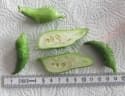
Cyclanthera pedata
Cyclanthera pedata
Safety & Hazards
None known
Cultivation Details
Achocha is a plant of the tropics, where it can be found at elevations up to 3,000 metres[1, 2]. It can also be cultivated in the subtropics and in areas of the temperate zone that have a long, warm growing season of 4 months or more[1]. Requires a very warm, sunny and sheltered position in a rich well-drained soil[3]. The first harvest of fruit can take place about 3 months after planting, and can then continue for several months[2]. There are many named forms[1]. Plants are not very cold-hardy in Britain and are normally grown in a greenhouse. However, if the plants are started in a greenhouse in the spring and grown on well it is possible to get reasonable yields in most years outdoors in Britain. Fruiting plants have been seen outdoors on a number of occasions at Kew Botanical gardens[PFAF].
Propagation
Seed - sow mid spring in a rich compost in a warm greenhouse. Put 2 or 3 seeds in a pot and thin the seedlings to the strongest plant. Plant out after the last expected frost and give the plants some protection such as a cloche until they are growing away well. Cite as: Temperate Plants Database, Ken Fern. temperate.theferns.info. 2026-02-21. <temperate.theferns.info/plant/Cyclanthera+pedata>
Pollinators
Insects
References
- [1]Lost Crops of the Incas — Popenoe. H. et al · National Academy Press · 1990 · ISBN 0-309-04264-X ↩︎An excellent book. Very readable, with lots of information and good pictures of some lesser known food plants of S. America.
- [2]Protabase - Plant Resources of Tropical Africa. — http://www.prota.org ↩︎An excellent on-line database with detailed information on over 3,200 species of useful plants of Africa.
- [3]The New RHS Dictionary of Gardening. 1992. — Huxley. A. · MacMillan Press · 1992 · ISBN 0-333-47494-5 ↩︎Excellent and very comprehensive, though it contains a number of silly mistakes. Readable yet also very detailed.
- [4]Raintree Nutrition - Tropical Plant Database — http://www.rain-tree.com/plants.htm ↩︎Detailed information on the medicinal uses of more than two hundred rainforest plants, mainly from S. America, with basic descriptions of the plants, their other uses etc.
- [5]Mansfeld's Database of Agricultural and Horticultural Plants — http://mansfeld.ipk-gatersleben.de/pls/htmldb_pgrc/f?p=185:3:4292127278597336 ↩︎Terse details of a huge range of useful plants.
- [6]Cornucopia - A Source Book of Edible Plants. — Facciola. S. · Kampong Publications · 1990 · ISBN 0-9628087-0-9 ↩︎Excellent. Contains a very wide range of conventional and unconventional food plants (including tropical) and where they can be obtained (mainly N. American nurseries but also research institutes and a lot of other nurseries from around the world.
- [7]Wild Food Plants of Australia. — Low. T. · Angus and Robertson. · 1989 · ISBN 0-207-14383-8 ↩︎Well presented, clear information and good photographs. An interesting read for the casual reader as well as the enthusiast
- [8]Cucurbitaceae — http://www.cucurbit.org ↩︎An excellent site with a wide range of information and some excellent pictures of plants in this family.
- [PFAF]Plants for a Future — pfaf.org ↩︎