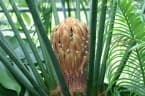
Cycas circinalis
Cycas circinalis
Safety & Hazards
The plants contain alkaloids of carcinogens and also an amino acid that causes chronic nervous disorders[1]. Regular consumption of the plant leads to severe health problems and death. This toxic principle can be removed if the food is properly prepared but consumption of the plant still cannot be recommended because its use often means the death of the plant and it is becoming rare in the wild. When fresh the seeds are so poisonous that the water in which they are steeped is fatal to chickens if drunk by them[2]. However, when they are split and soaked in several changes of water, the poison is released from the seeds and they are eaten
Cultivation Details
Cycas circinalis is able to succeed in the hot tropics and subtropics, growing best in areas with a distinct wet/dry seasonality[3]. Plants are tolerant of light frost[3]. Prefers a sunny position, but also succeeds in light shade[4, 5]. In cultivation it requires a strong loam with sharp sand and good drainage[6], but in the wild it succeeds in dry soils and in poor soils[5]. Cycads will generally not grow well in clay soils unless those soils are heavily amended with sand and organic matter[7]. A neutral soil (pH 7), is generally best for most species of cycads and allows the proper absorption of nutrients. A slightly acid soil is better for most cycads than a basic one[7]. Plants are slow-growing[4]. Species in this genus can usually be transplanted easily even when quite large. The best time for moving them is just before the beginning of a new growing season, the roots being trimmed if they are damaged and perhaps some leaves being removed. New roots should develop quickly as the season progresses[7]. Species in this genus form structures known as coralloid roots. These roots branch off from the taproot or secondary roots and are distinctive in that they grow laterally or upward, forming a nodular mass at the apex. These coralloid roots occur slightly below or slightly above the soil surface and generally contain cyanobacteria, also known as blue-green algae. These are able to fix atmospheric nitrogen and make it available as a nutrient to the plant. The ability to extract this important nutrient from the air explains how many cycad species are able to survive on almost sterile soils[8, 7]. A dioecious species, with individual plants producing either all male or all female cones. Therefore both male and female forms of the plant need to be grown if seed is required[7]. On very rare occasions, usually when a plant has been under severe stress, it can change sex and produce either all female or all male cones[7].
Propagation
Seed - best sown in a greenhouse as soon as it is ripe, 2cm deep in individual pots which are then sealed in plastic bags to keep them moist until germination takes place. Germinates in 1 - 3 months at 25°c[9]. Pre-soak stored seed for 24 hours in warm water then treat as above. Division of suckers in the spring[4]. Cite as: Temperate Plants Database, Ken Fern. temperate.theferns.info. 2026-02-21. <temperate.theferns.info/plant/Cycas+circinalis>
Pollinators
Insects, wind
References
- [1]The New RHS Dictionary of Gardening. 1992. — Huxley. A. · MacMillan Press · 1992 · ISBN 0-333-47494-5 ↩︎Excellent and very comprehensive, though it contains a number of silly mistakes. Readable yet also very detailed.
- [2]The Useful Plants of the Island of Guam — Safford W.E. · Smithsonian Institute; Washington. · 1905 · http://www.biodiversitylibrary.org/ ↩︎A very comprehensive, if rather dated, guide to the plants of Guam. It can be downloaded from the Internet.
- [3]Perennial Edible Fruits of the Tropics : an Inventory — Martin, F. W.; Campbell, C. W.; Rubertbe, R. M. · U.S. Dept. of Agriculture, Agricultural Research Service · 1987 ↩︎A booklet giving terse details of almost 300 species of edible fruits, plus regional lists of Botanical and Common names for over 2,500 less well-known edible fruits of the tropics.
- [4]The RHS Gardener's Encyclopedia of Plants and Flowers — Brickell. C. · Dorling Kindersley Publishers Ltd. · 1990 · ISBN 0-86318-386-7 ↩︎Excellent range of photographs, some cultivation details but very little information on plant uses.
- [5]Tropical Ornamentals; A Guide — Whistler. W. Arthur. · Timber Press Inc. Oregon. · 2000 · ISBN 0-88192-448-2 ↩︎An excellent little guide to some of the more commonly cultivated ornamental plants of the Tropics, often giving some information on the plants other uses.
- [6]RHS Dictionary of Plants plus Supplement. 1956 — F. Chittendon. · Oxford University Press · 1951 · ISBN - ↩︎Comprehensive listing of species and how to grow them. Somewhat outdated, it has been replaced in 1992 by a new dictionary (see [ 200 ]).
- [7]The Cycads — Whitelock L.M. · Timber Press; Portland, Oregon · 2002 · ISBN 0-88192-522-5 ↩︎An excellent book dealing with the eleven different genera and almost 300 species of plants we know as Cycads. There are detailed descriptions and a host of other information for each species.
- [8]Focus on Plants. Volume 5. (formerly 'Growing from seed') — Bird. R. (Editor) · Thompson and Morgan. · 1991 · ISBN - ↩︎Very readable magazine with lots of information on propagation. A good article on Corydalis spp.
- [9]Growing from Seed. Volume 4. — Bird. R. (Editor) · Thompson and Morgan. · 1990 · ISBN - ↩︎Very readable magazine with lots of information on propagation. A good article on Yuccas, one on Sagebrush (Artemesia spp) and another on Chaerophyllum bulbosum.
- [10]Palm and Cycad Societies of Australia. — http://www.pacsoa.org.au/ ↩︎Contains at least a little information on the majority of palm and cycad species, plus a wealth of photographs. A first class website.
- [11]The Cycad Pages — Royal Botanic Gardens, Sydney. · 2012 · http://plantnet.rbgsyd.nsw.gov.au/PlantNet/cycad/wlist.html ↩︎A website dedicated to the various species of Cycad, with a comprehensive description of all the known species (as of 2012). At present (2015), the site is still running but is no longer being updated
- [12]A Taxonomic Revision of the Genera Cycas and Epicycas gen. nov. (Cycadaceae) — de Laubenfels D.J. & Adema F. · 1998 ↩︎
- [13]Economic Botany of the Cycads — Thieret J.W. · 1958 · https://doi.org/10.1007/BF02863122 ↩︎
- [14]IUCN Red List of Threatened Species — http://www.iucnredlist.org/ ↩︎A list of plants under threat and facing possible extinction, usually with brief details of the threats and information on habitat.
- [15]Sturtevant's Edible Plants of the World. — Hedrick. U. P. · Dover Publications · 1972 · ISBN 0-486-20459-6 ↩︎Lots of entries, quite a lot of information in most entries and references.
- [16]Dictionary of Economic Plants. — Uphof. J. C. Th. · Weinheim · 1959 · ISBN - ↩︎An excellent and very comprehensive guide but it only gives very short descriptions of the uses without any details of how to utilize the plants. Not for the casual reader.
- [17]A Dictionary of Plants Used by Man. — Usher. G. · Constable · 1974 · ISBN 0094579202 ↩︎Forget the sexist title, this is one of the best books on the subject. Lists a very extensive range of useful plants from around the world with very brief details of the uses. Not for the casual reader.
- [18]Plants for Human Consumption. — Kunkel. G. · Koeltz Scientific Books · 1984 · ISBN 3874292169 ↩︎An excellent book for the dedicated. A comprehensive listing of Latin names with a brief list of edible parts.
- [19]Nuts. — Howes. F. N. · Faber · 1948 · ISBN - ↩︎Rather old but still a masterpiece. Has sections on tropical and temperate plants with edible nuts plus a section on nut plants in Britain. Very readable.
- [20]A Manual of Indian Timbers. — Gamble. J. S. · Bishen Singh Mahendra Pal Singh · 1972 · ISBN - ↩︎First written in the 19th century, but still a classic, giving a lot of information on the uses and habitats of Indian trees. Not for the casual reader.
- [21]Plants of Guam — Moore P.H. & McMakin P. · University of Guam. · 1979 · http://university.uog.edu/cals/people/POG/scipn.htm ↩︎Brief details, usually with a photo, of plants native to the island of Guam, often together with some information on their uses. An online version is available.
- [22]Mansfeld's Database of Agricultural and Horticultural Plants — http://mansfeld.ipk-gatersleben.de/pls/htmldb_pgrc/f?p=185:3:4292127278597336 ↩︎Terse details of a huge range of useful plants.
- [23]Vegetable Gums and Resins. — Howes. F. N. · Faber · ISBN 81-88818-17-8 ↩︎A very good book dealing with the subject in a readable way.
- [24]Economic Botany. — Hill. A. F. · The Maple Press · 1952 · ISBN - ↩︎Not very comprehensive, but it is quite readable and goes into some detail about the plants it does cover.
- [25]A Modern Herbal. — Grieve. · Penguin · 1984 · ISBN 0-14-046-440-9 ↩︎Not so modern (1930's?) but lots of information, mainly temperate plants.
- [26]Plants for Man. — Schery. R. W. ↩︎Fairly readable but not very comprehensive. Deals with plants from around the world.
- [27]Tanaka's Cyclopedia of Edible Plants of the World. — Tanaka. T. & Nakao S. · Keigaku Publishing; Tokyo · 1976 · ISBN - ↩︎The most comprehensive list of edible plants I've come across. Only the briefest entry for each species, though, and some of the entries are more than a little dubious. Not for the casual reader.
- [28]The Plant Wealth of Iraq. — Chakravarty. H. L. ↩︎It is surprising how many of these plants can be grown in Britain. A very readable book on the useful plants of Iraq.
- [29]Encyclopaedia of Herbs and their Uses. — Bown. D. · Dorling Kindersley, London. · 1995 · ISBN 0-7513-020-31 ↩︎A very well presented and informative book on herbs from around the globe. Plenty in it for both the casual reader and the serious student. Just one main quibble is the silly way of having two separate entries for each plant.
- [30]Glossary of Indian Medicinal Plants (Including the Supplement). — Chopra. R. N., Nayar. S. L. and Chopra. I. C. · Council of Scientific and Industrial Research, New Delhi. · 1986 · ISBN - ↩︎Very terse details of medicinal uses of plants with a wide range of references and details of research into the plants chemistry. Not for the casual reader.
- [31]Medicinal Plants in Papua New Guinea — World Health Organisation · 2009 · ISBN 978-92-9061-249-0 ↩︎Traditional medicinal uses of 126 species from Papua New Guinea, including information on modern research into the plants.
- [32]Flora of the USSR. — Komarov. V. L. · Israel Program for Scientific Translation · 1968 · http://www.biodiversitylibrary.org · ISBN - ↩︎An immense (25 or more large volumes) and not yet completed translation of the Russian flora. Full of information on plant uses and habitats but heavy going for casual readers. It can be downloaded from the Internet.
- [33]Agroforestry in the Pacific Islands: Systems for Sustainability — W.C. Clarke and R.R. Thaman (Editors) · United Nations University Press, Tokyo · 1993 · http://www.unu.edu/unupress/unupbooks/80824e/80824E00.htm#Contents · ISBN 92-808-0824-9 ↩︎The guide includes information on 100 species of plants for Agroforestry. It is also available on the web at the address given above.