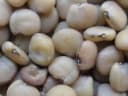
Cyamopsis tetragonoloba
Cyamopsis tetragonoloba
Safety & Hazards
The immature seedpods contain high contents of hydrocyanic acid, though by the time the pods mature this has been reduced to a trace[1].
Cultivation Details
Cyamopsis tetragonoloba is suitable for growing in the warm temperate zone as an annual, although it is more commonly grown in lowland tropical and subtropical areas up to an elevation of 1,000 metres[2]. Tolerating high temperatures, it requires a high level of solar radiation in order to do well[2]. Grows best when the soil temperature is in the range of 25 - 30°c, bur able to tolerate temperatures to 45°c[2, 3]. Prefers an annual rainfall in the range of 500 - 800mm, but can tolerate up to 2,700mm[2, 3]. Dry weather is essential once fertilization has taken place - the developing pods can be damaged by high humidity or rainfall[2]. Prefers a sunny position[3]. Grows best in alluvial and sandy loam soils[2]. Established plants are very drought resistant[2]. Some forms are tolerant of poor soils, alkaline or saline conditions[2]. Prefers a pH in the range 7.5 - 8, tolerating 5.5 - 8.5[2, 3]. Young pods can be harvested 2 - 3 months after sowing the seed[2]. Yields of 6 - 8 tonnes per hectare of the pods have been obtained[2]. Approximately 800kg of dried seed per hectare is considered average[2]. There are some named varieties[2, 4]. Many cultivars are daylength sensitive, though many new cultivars are daylength neutral[2]. The plant has a vigorous taproot[1]. This species has a symbiotic relationship with certain soil bacteria, these bacteria form nodules on the roots and fix atmospheric nitrogen. Some of this nitrogen is utilized by the growing plant but some can also be used by other plants growing nearby[1].
Propagation
The seed has a hard seedcoat and may benefit from scarification before sowing in order to speed up and improve germination. This can usually be done by pouring a small amount of nearly boiling water on the seeds (being careful not to cook them!) and then soaking them for 12 - 24 hours in warm water. By this time they should have imbibed moisture and swollen - if they have not, then carefully make a nick in the seedcoat (being careful not to damage the embryo) and soak for a further 12 hours before sowing. Inoculating the seed with Rhizobium bacterium may be necessary in order for the plant to establish and perform well[2]. Cite as: Temperate Plants Database, Ken Fern. temperate.theferns.info. 2026-02-21. <temperate.theferns.info/plant/Cyamopsis+tetragonoloba>
Pollinators
Data unavailable
References
- [1]The New RHS Dictionary of Gardening. 1992. — Huxley. A. · MacMillan Press · 1992 · ISBN 0-333-47494-5 ↩︎Excellent and very comprehensive, though it contains a number of silly mistakes. Readable yet also very detailed.
- [2]Vegetables in the Tropics — Tindall. H. D. · MacMillan, Oxford. · 1983 · ISBN 0-333-24268-8 ↩︎An excellent, in-depth look at the main vegetable crops that can be grown in the Tropics, plus many less well-known plants.
- [3]Ecocrop — http://ecocrop.fao.org/ecocrop/srv/en/home ↩︎Basic information on a wide range of useful plants, plus details of environmental needs where available.
- [4]Cornucopia II — Facciola. S. · Kampong Publications, California. · 1998 · ISBN 0-9628087-2-5 ↩︎The second edition of an excellent guide to the edible uses of plants, though it does not give any details of cultivation etc.
- [5]Plant Resources of Southeast Asia — http://proseanet.org/ ↩︎Lots of information on the uses of the plants of SE Asia.
- [6]The Encyclopedia of Medicinal Plants — Chevallier. A. · Dorling Kindersley. London · 1996 · ISBN 9-780751-303148 ↩︎An excellent guide to over 500 of the more well known medicinal herbs from around the world.