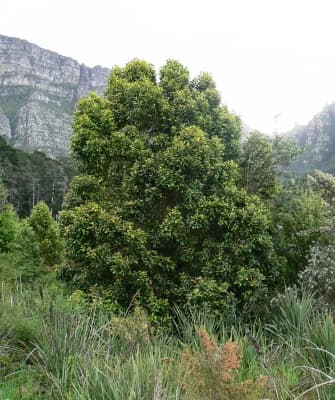
Curtisia dentata
Curtisia dentata
Safety & Hazards
None known
Cultivation Details
Assegai succeeds in tropical and subtropical regions, though is far less common in the tropics. It prefers areas with a distinct dry season and does not do so well in drier or wetter zones[1]. Prefers a deep, humus-rich, fertile soil and a position in full sun[1]. Young plants are capable of living in the dense shade of a natural forest, but they grow faster under higher light intensities[1]. Established plants are capable of withstanding moderate drought[1]. A fairly fast-growing tree[1]. Trees grow comparatively slowly under natural conditions, but may be fast-growing in cultivation[2]. Cut stumps coppice freely and the roots give off suckers[1]. A deep-rooted species, it does not form a heavy crown and has remarkably tough branches that are rarely broken by severe winds[1].
Propagation
Seed - remove the fleshing covering of the berry and sow the nut when fresh, covered lightly and keep warm and moist[1]. Germination takes 3 to 4 weeks[295. Seedlings are vigorous but highly susceptible to injury from drought, high surface soil temperature, frost and damping off fungi. They are thus best kept moist, but not wet, in light shade and protected from frost and full sun[1]. About 50% of the viable seeds that drop from the tree actually produce seedlings. In nature, the seeds normally germinate 6 to 12 months but never more than 15 to 18 months after the fruits drop, the delay probably being due to the time taken for the corky pericarp and the hard nut that encloses them to decay[1]. Cite as: Tropical Plants Database, Ken Fern. tropical.theferns.info. 2026-02-20. <tropical.theferns.info/viewtropical.php?id=Curtisia+dentata>
Pollinators
Self, Wind
References
- [1]PlantZAfrica.com — http://www.plantzafrica.com ↩︎An excellent site giving detailed descriptions and uses of many S. African plants.
- [2]Protabase - Plant Resources of Tropical Africa. — http://www.prota.org ↩︎An excellent on-line database with detailed information on over 3,200 species of useful plants of Africa.
- [3]Flora Zambesiaca — http://apps.kew.org/efloras/fz/intro.html ↩︎An excellent online flora of plants from the Zambezi River basin. It lists a number of the plant uses as well as the habitats and botanical descriptions of the plants.
- [4]Dictionary of Economic Plants. — Uphof. J. C. Th. · Weinheim · 1959 · ISBN - ↩︎An excellent and very comprehensive guide but it only gives very short descriptions of the uses without any details of how to utilize the plants. Not for the casual reader.
- [PFAF]Plants for a Future — pfaf.org ↩︎