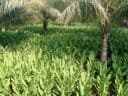
Curcuma longa
Curcuma longa
Safety & Hazards
If the roots are cut the yellow colour will stain fingers or cloth indelibly, and contact may cause an allergic skin reaction in some people.
Cultivation Details
Turmeric is a plant of the moist tropics and subtropics, where it is found at elevations up to 2,000 metres. It grows best in areas where annual daytime temperatures are within the range 20 - 28°c, but can tolerate 18 - 32°c[1]. It prefers a mean annual rainfall in the range 1,000 - 2,000mm, but tolerates 800 - 3,000mm[1]. Prefers a fertile, well-drained soil in a shaded position[2, 1]. Succeeds in full sun and in light shade[1]. Prefers a pH in the range 6 - 7, tolerating 5.5 - 7.5[1]. In India the crop is planted just before the rainy season. The leaves appear above ground in about 30 days, and the crop is harvested when the leaves wither after 270 - 365 days[1]. Yields of fresh raw turmeric usually vary between 7 - 9 tonnes per hectare when turmeric is grown as a rain-fed crop, and between 17 - 25 tonnes when it is grown under irrigation[1]. Yields up to 50 tonnes have been obtained[1]. The yield of the dried spice varies between 400 - 1,700 kilos/ha[1]. Plants are adapted to growing in areas of seasonal drought in monsoonal forests[3].
Propagation
Seed - best sown as soon as it is ripe[3]. Germinates best at temperatures around 20°c[3]. Division of the rhizome when the plant is dormant. Cite as: Tropical Plants Database, Ken Fern. tropical.theferns.info. 2026-02-20. <tropical.theferns.info/viewtropical.php?id=Curcuma+longa>
Pollinators
Data unavailable
References
- [1]Ecocrop — http://ecocrop.fao.org/ecocrop/srv/en/home ↩︎Basic information on a wide range of useful plants, plus details of environmental needs where available.
- [2]Cornucopia II — Facciola. S. · Kampong Publications, California. · 1998 · ISBN 0-9628087-2-5 ↩︎The second edition of an excellent guide to the edible uses of plants, though it does not give any details of cultivation etc.
- [3]The New RHS Dictionary of Gardening. 1992. — Huxley. A. · MacMillan Press · 1992 · ISBN 0-333-47494-5 ↩︎Excellent and very comprehensive, though it contains a number of silly mistakes. Readable yet also very detailed.
- [4]Protabase - Plant Resources of Tropical Africa. — http://www.prota.org ↩︎An excellent on-line database with detailed information on over 3,200 species of useful plants of Africa.
- [5]Encyclopaedia of Herbs and their Uses. — Bown. D. · Dorling Kindersley, London. · 1995 · ISBN 0-7513-020-31 ↩︎A very well presented and informative book on herbs from around the globe. Plenty in it for both the casual reader and the serious student. Just one main quibble is the silly way of having two separate entries for each plant.
- [6]Plant Resources of Southeast Asia — http://proseanet.org/ ↩︎Lots of information on the uses of the plants of SE Asia.
- [7]Tropical Food Gardens — Norrington. L. · Bloomings Books (Melbourne) · 2001 · ISBN 1-876473-41-x ↩︎Excellent little book giving some basic information on a range of plants.
- [8]The Encyclopedia of Medicinal Plants — Chevallier. A. · Dorling Kindersley. London · 1996 · ISBN 9-780751-303148 ↩︎An excellent guide to over 500 of the more well known medicinal herbs from around the world.
- [9]Medicinal Plants in Vietnam — Nguyen Van Dan & Doan Thi Nhu · World Health Organisation · 1989 · ISBN 92 9061 101 4 ↩︎An excellent book, giving information on over 200 plants, their medicinal compounds and applications.
- [10]Medicinal Plants in the South Pacific — WHO Regional Publications, Manilla. · 1998 · ISBN 92-9061-118-9 ↩︎Excellent guide to 102 medicinal herbs of the Pacific Islands, with photographs of each plant and details of their constituents, biological activities and traditional uses. A description of each plant, together with habitat and distribution is given.
- [11]Dictionary of Economic Plants. — Uphof. J. C. Th. · Weinheim · 1959 · ISBN - ↩︎An excellent and very comprehensive guide but it only gives very short descriptions of the uses without any details of how to utilize the plants. Not for the casual reader.