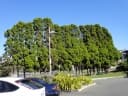
Cupressus torulosa
Cupressus torulosa
Safety & Hazards
None known
Cultivation Details
Cupressus torulosa is a plant of moderate to high elevations in the warm temperate zone, though it has also been cultivated in the subtropics and at higher elevations in the tropics, where it is grown at elevations up to 3,000 metres. It grows best in areas where annual daytime temperatures are within the range 20 - 32°c, but can tolerate 5 - 45°c[1]. When dormant, the plant can survive temperatures down to about -9°c, but young growth can be severely damaged at -1°c[1]. It prefers a mean annual rainfall in the range 800 - 1,600mm, but tolerates 650 - 2,400mm[1]. Requires a sunny position[2]. Thrives in a well-drained loamy or peaty soil[3] and can succeeds in calcareous conditions[4]. Prefers cooler wetter summers than other members of this genus[5]. Tolerates poor sandy soils[2] but is then more subject to insect damage in a succession of dry seasons[3]. Subject to injury by the wind. Prefers a pH of 6 or lower[5]. The tree is rather slow growing[4]. Cones can remain closed on the tree for a number of years, opening after the heat of a forest fire to scatter their seeds which then germinate and grow away quickly in the ashes of the fire[5]. The crushed foliage smells of lawn mowings[6]. Trees are notably susceptible to honey fungus[5].
Propagation
Seed - sow late winter in a cold frame and only just cover the seed[7]. Three weeks cold stratification can improve germination rates[7]. The seed usually germinates in 1 - 2 months at 20°c. The seedlings are very subject to damping off so should be watered with care and kept well-ventilated[8]. When they are large enough to handle, prick the seedlings out into individual pots and grow them on in the greenhouse for at least their first winter. Plant them out into their permanent positions in late spring or early summer, after the last expected frosts. The seed can store for several years[8]. Cuttings of almost ripe wood, September in a frost-proof frame[9]. mid spring is the best time to take cuttings[8]. Cite as: Temperate Plants Database, Ken Fern. temperate.theferns.info. 2026-02-21. <temperate.theferns.info/plant/Cupressus+torulosa>
Pollinators
Wind
References
- [1]Ecocrop — http://ecocrop.fao.org/ecocrop/srv/en/home ↩︎Basic information on a wide range of useful plants, plus details of environmental needs where available.
- [2]Conifers. — Rushforth. K. · Christopher Helm · 1987 · ISBN 0-7470-2801-X ↩︎Deals with conifers that can be grown outdoors in Britain. Good notes on cultivation and a few bits about plant uses.
- [3]Trees and Shrubs Hardy in Great Britain. Vol 1 - 4 and Supplement. — Bean. W. · Murray · 1981 · ISBN - ↩︎A classic with a wealth of information on the plants, but poor on pictures.
- [4]World Agroforesty Centre — http://www.worldagroforestry.org/ ↩︎An excellent online database of a huge range of trees giving very good information on each plant - its uses, ecology, identity, propagation, pests etc.
- [5]The New RHS Dictionary of Gardening. 1992. — Huxley. A. · MacMillan Press · 1992 · ISBN 0-333-47494-5 ↩︎Excellent and very comprehensive, though it contains a number of silly mistakes. Readable yet also very detailed.
- [6]Conifers in the British Isles. — Mitchell. A. F. · HMSO · 1975 · ISBN 0-11-710012-9 ↩︎A bit out of date (first published in 1972), but an excellent guide to how well the various species of conifers grow in Britain giving locations of trees.
- [7]Growing from Seed. Volume 4. — Bird. R. (Editor) · Thompson and Morgan. · 1990 · ISBN - ↩︎Very readable magazine with lots of information on propagation. A good article on Yuccas, one on Sagebrush (Artemesia spp) and another on Chaerophyllum bulbosum.
- [8]The Reference Manual of Woody Plant Propagation. — Dirr. M. A. and Heuser. M. W. · Athens Ga. Varsity Press · 1987 · ISBN 0942375009 ↩︎A very detailed book on propagating trees. Not for the casual reader.
- [9]RHS Dictionary of Plants plus Supplement. 1956 — F. Chittendon. · Oxford University Press · 1951 · ISBN - ↩︎Comprehensive listing of species and how to grow them. Somewhat outdated, it has been replaced in 1992 by a new dictionary (see [ 200 ]).
- [10]Protabase - Plant Resources of Tropical Africa. — http://www.prota.org ↩︎An excellent on-line database with detailed information on over 3,200 species of useful plants of Africa.
- [11]IUCN Red List of Threatened Species — http://www.iucnredlist.org/ ↩︎A list of plants under threat and facing possible extinction, usually with brief details of the threats and information on habitat.
- [12]Flowers of the Himalayas. — Polunin. O. and Stainton. A. · Oxford Universtiy Press · 1984 · ISBN - ↩︎A very readable and good pocket guide (if you have a very large pocket!) to many of the wild plants in the Himalayas. Gives many examples of plant uses.
- [13]Forest Flora of Chakrata, Dehra Dun and Saharanpur. — Gupta. B. L. · Forest Research Institute Press · 1945 · ISBN - ↩︎A good flora for the middle Himalayan forests, sparsly illustrated. Not really for the casual reader.
- [14]Plants and People of Nepal — Manandhar. N. P. · Timber Press. Oregon. · 2002 · ISBN 0-88192-527-6 ↩︎Excellent book, covering over 1,500 species of useful plants from Nepal together with information on the geography and peoples of Nepal. Good descriptions of the plants with terse notes on their uses.
- [15]A Handbook of the World's Conifers Vol. 1 (Second revised edition) — Farjon A. · Brill; Leiden, The Netherlands · 2017 · ISBN 978 90 04 32449 7 ↩︎
- [16]Non-Timber Forest Products of Nepal Himalaya - database of some important species found in the mountain protected ar — Ghimire S.K. et al · WWF Nepal, Kathmandu, Nepal · 2008 · ISBN 978-99946-837-9-6 ↩︎
- [17]A Dictionary of Plants Used by Man. — Usher. G. · Constable · 1974 · ISBN 0094579202 ↩︎Forget the sexist title, this is one of the best books on the subject. Lists a very extensive range of useful plants from around the world with very brief details of the uses. Not for the casual reader.