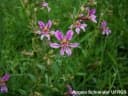
Cuphea glutinosa
Cuphea glutinosa
Safety & Hazards
None known
Cultivation Details
Cuphea glutinosa is native to the subtropics of south eastern S. America, just moving into the tropics. In trials in southeastern N. America, forms have been selected that can tolerate temperatures falling to at least -7°c for short periods[1]. Plants require a sunny position[1].
Propagation
Seed - can be sown in situ after the last expected frosts[2]. In order to obtain larger plants, extend the growing season and hopefully achieve larger yields of seeds, the seeds can be sown in a greenhouse in early spring at around 21°c. Germination usually takes a few weeks because of the hard seed coat. Prick the seedlings out into individual pots as soon as they are large enough to handle and plant out after the last expected frosts[2]. Division Cite as: Temperate Plants Database, Ken Fern. temperate.theferns.info. 2026-02-21. <temperate.theferns.info/plant/Cuphea+glutinosa>
Pollinators
Data unavailable
References
- [1]Advances in New Crops. Proceedings of the First National Symposium NEW CROPS: Research, Development, Economics — Jules Janick and J.E.Simon (eds.) · Timber Press, Portland, Oregon · 1990 · ISBN 0-88192-166-1 ↩︎This book is the proceedings of the First National Symposium on New Crops held October 23-26, 1988 in Indianapolis, Indiana. The contents include papers from invited speakers, papers derived from posters, and abstracts from poster presentations
- [2]The New RHS Dictionary of Gardening. 1992. — Huxley. A. · MacMillan Press · 1992 · ISBN 0-333-47494-5 ↩︎Excellent and very comprehensive, though it contains a number of silly mistakes. Readable yet also very detailed.
- [3]The National Non-Food Crops Centre Crop Database — http://www.nnfcc.co.uk/crops/pd.cfm ↩︎An excellent on-line information source, with information on over 100 species (as of 2006) of plants being investigated as bio-crops.
- [4]Dictionary of Economic Plants. — Uphof. J. C. Th. · Weinheim · 1959 · ISBN - ↩︎An excellent and very comprehensive guide but it only gives very short descriptions of the uses without any details of how to utilize the plants. Not for the casual reader.
- [5]A comprehensive review of Cuphea (Lythraceae) — Mohamed R Elgindi; Nahla Ayoub; Rola Milad and Reham Hassan · 2011 · ISBN 0975-8585 ↩︎Gives information on the traditional medicinal uses of various cuphea species, and also a review of modern research and the compounds the plants contain.
- [6]In vitro evaluation of trypanocidal activity in plants used in Argentine traditional medicine — V. Sülsen; C. Güida; J. Coussio; C. Paveto; L. Muschietti; V · 2006 · ISBN DOI 10.1007/s0043 ↩︎