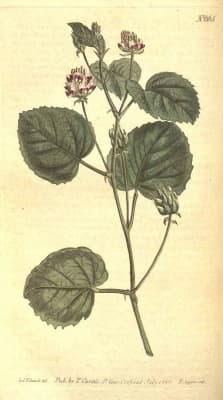
Cullen corylifolium
Cullen corylifolium
Safety & Hazards
Although no specific mention of toxicity for this species has been found, at least some members of this genus contain furanocoumarins, these substances can cause photosensitivity in some people[1].
Cultivation Details
Cullen corylifolium is native to the warm temperate to tropical zones of southern Asia. It is not very cold-hardy, tolerating occasional temperatures down to about -4°c, but can be grown as an annual in areas with warm to hot summers. Succeeds in an ordinary garden soil[2]. Requires a well-drained soil in a sunny position[3]. Plants are very intolerant of root disturbance, they are best planted out into their permanent positions whilst still small[3]. This species has a symbiotic relationship with certain soil bacteria, these bacteria form nodules on the roots and fix atmospheric nitrogen. Some of this nitrogen is utilized by the growing plant but some can also be used by other plants growing nearby[3].
Propagation
Pre-soak the seed for 24 hours in warm water and then sow in early to mid spring in a greenhouse. Either sow the seed in individual pots or pot up the young seedlings as soon as possible in order to avoid root disturbance. Grow them on in the pots until planting out in their final positions. It is usually impossible to transplant this species without fatal damage to the root[3]. Division in spring. With great care since the plant resents root disturbance. It is virtually impossible to divide this species successfully[3]. Cite as: Temperate Plants Database, Ken Fern. temperate.theferns.info. 2026-02-21. <temperate.theferns.info/plant/Cullen+corylifolium>
Pollinators
Insects
References
- [1]A Colour Atlas of Poisonous Plants. — Frohne. D. and Pfänder. J. · Wolfe · 1984 · ISBN 0723408394 ↩︎Brilliant. Goes into technical details but in a very readable way. The best work on the subject that I've come across so far.
- [2]RHS Dictionary of Plants plus Supplement. 1956 — F. Chittendon. · Oxford University Press · 1951 · ISBN - ↩︎Comprehensive listing of species and how to grow them. Somewhat outdated, it has been replaced in 1992 by a new dictionary (see [ 200 ]).
- [3]The New RHS Dictionary of Gardening. 1992. — Huxley. A. · MacMillan Press · 1992 · ISBN 0-333-47494-5 ↩︎Excellent and very comprehensive, though it contains a number of silly mistakes. Readable yet also very detailed.
- [4]Plant Resources of Southeast Asia — http://proseanet.org/ ↩︎Lots of information on the uses of the plants of SE Asia.
- [5]Flora of China — Missouri Botanical Garden Press; St. Louis. · 1994 · http://flora.huh.harvard.edu/china/ ↩︎An excellent, comprehensive resource in 25 volumes. In addition to the botanical information the flora also gives basic information on habitat and some uses. An on-line version is also available.
- [6]Plants for Human Consumption. — Kunkel. G. · Koeltz Scientific Books · 1984 · ISBN 3874292169 ↩︎An excellent book for the dedicated. A comprehensive listing of Latin names with a brief list of edible parts.
- [7]The Encyclopedia of Medicinal Plants — Chevallier. A. · Dorling Kindersley. London · 1996 · ISBN 9-780751-303148 ↩︎An excellent guide to over 500 of the more well known medicinal herbs from around the world.
- [8]Therapeutic Anabolic and Anticatabolic Benefits of Natural Chinese Medicines for the Treatment of Osteoporosis — He J., Li X., Wang Z. et al · 2019 · http://10.3389/fphar.2019.01344 ↩︎
- [9]Medicinal Plants of China — Duke. J. A. and Ayensu. E. S. · Reference Publications, Inc. · 1985 · ISBN 0-917256-20-4 ↩︎Details of over 1,200 medicinal plants of China and brief details of their uses. Often includes an analysis, or at least a list of constituents. Heavy going if you are not into the subject.
- [10]A Modern Herbal. — Grieve. · Penguin · 1984 · ISBN 0-14-046-440-9 ↩︎Not so modern (1930's?) but lots of information, mainly temperate plants.
- [11]A Barefoot Doctors Manual. — ? · Running Press; Philadelphica. · 1977 · ISBN 0-914294-92-X ↩︎A very readable herbal from China, combining some modern methods with traditional chinese methods.
- [12]Handbook of Chinese Herbs and Formulas. — Yeung. Him-Che. · Institute of Chinese Medicine, Los Angeles · 1985 · ISBN - ↩︎An excellent Chinese herbal giving information on over 500 species. Rather technical and probably best suited to the more accomplished user of herbs.
- [13]Chinese Materia Medica. — Stuart. Rev. G. A. · Taipei. Southern Materials Centre · 1911 · ISBN - ↩︎A translation of an ancient Chinese herbal. Fascinating.
- [14]Glossary of Indian Medicinal Plants (Including the Supplement). — Chopra. R. N., Nayar. S. L. and Chopra. I. C. · Council of Scientific and Industrial Research, New Delhi. · 1986 · ISBN - ↩︎Very terse details of medicinal uses of plants with a wide range of references and details of research into the plants chemistry. Not for the casual reader.
- [15]Green Manures and Manuring in the Tropics — Sornay P. De. Translated by Flattely F.W. · John Bale, Sons and Danielsson Ltd.: London · 1916 · http://www.biodiversitylibrary.org ↩︎An excellent work on the subject, even if it was written almost 100 years ago. It also includes a section of useful Legumes. Can be downloaded from the Internet.
- [16]CosIng — http://ec.europa.eu/growth/tools-databases/cosing/ ↩︎CosIng is the European Commission database for information on cosmetic substances and ingredients.