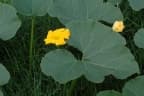
Cucurbita maxima
Cucurbita maxima
Safety & Hazards
The sprouting seed produces a toxic substance in its embryo[1].
Cultivation Details
Most cultivars of Cucurbita maxima are relatively insensitive to day-length[2], and so the plant can be grown from the temperate zone to the tropics so long as there is a warm growing season of at least 150 days. It can be grown at elevations up to 2,000 metres in the tropics. It grows best in areas where annual daytime temperatures are within the range 20 - 30°c, but can tolerate 9 - 38°c[3]. It can be killed by temperatures of 0°c or lower. It prefers a mean annual rainfall in the range 600 - 1,000mm, but tolerates 450 - 2,700mm[3]. Requires a rich, well-drained moisture retentive soil and a sheltered position in the sun or light shade[4, 5, 6]. Prefers a pH in the range 5.5 to 7.5, but tolerates 5 - 8.5[5, 3]. Dry periods with a relatively low humidity favour the best growth - plants are more susceptible to leaf diseases in damp seasons[2, 7]. Fruits may be harvested 80 - 140 days from sowing or planting[3]. Yields vary according to variety grown, but with good care, a yield of 15 tonnes per hectare is reasonable, and with improved cultivars a yield of 30 tonnes is possible[6]. Excessive picking of the young leaves and shoots reduces fruit yield[6]. Seed yield is variable, possibly 300 - 500 kilos per hectare[6]. This species can only be crossed with most other species in the genus under controlled conditions[5, 8]. The wild ancestor of Cucurbita maxima, treated here as Cucurbita maxima andreana Filov, has bitter-tasting fruits and leaves and is not usually eaten. However, it has a number of medicinal uses and so is treated in more detail on a separate record[PFAF]. There are three major species in this genus that are cultivated for their fruits (Cucurbita maxima, Cucurbita moschata and Cucurbita pepo), and they are often not easy to distinguish. The plant habit is similar and the fruit shape and size within each species are variable. Distinction is easiest by observing differences of the fruit stalk, stems and leaves:- Cucurbita maxima has a soft, rounded fruit stalk not enlarged at the apex, soft, rounded stems and soft, usually unlobed leaves[6]. Cucurbita moschata has a hard, smoothly angled fruit stalk widened at the apex, hard, smoothly grooved stems and soft, moderately lobed leaves[6]. Cucurbita pepo has an angular fruit stalk sometimes slightly widened at the apex, hard, angular, grooved, prickly stems and palmately lobed, often deeply cut and prickly leaves[6]. Most of the winter squashes derive from Cucurbita maxima, including Hubbard, Butternut, Acorn, Argentine and Boston[5]. Most cultivars are relatively insensitive to day-length[2]. This species hybridizes readily with Cucurbita andreana (sometimes seen as a subspecies of this species) but can only be crossed with other species under controlled conditions[5, 8]. This species hybridizes readily with C. andreana but can only be crossed with other species under controlled conditions[5, 8]. Some modern works see C. andreana as being no more than a subspecies of this species, classifying it as C. maxima andreana (Naudin.)Filov. Grows well with sweetcorn and thornapple but dislikes potatoes[9, 10].
Propagation
Seed - sow early to mid spring in a greenhouse in a rich soil. Germination should take place within 2 weeks. Sow 2 or 3 seeds per pot and thin out to the best plant. Grow them on fast and plant out after the last expected frosts, giving them cloche or frame protection for at least their first few weeks if you are trying them outdoors. Cite as: Temperate Plants Database, Ken Fern. temperate.theferns.info. 2026-02-21. <temperate.theferns.info/plant/Cucurbita+maxima>
Pollinators
Insects
References
- [1]A Colour Atlas of Poisonous Plants. — Frohne. D. and Pfänder. J. · Wolfe · 1984 · ISBN 0723408394 ↩︎Brilliant. Goes into technical details but in a very readable way. The best work on the subject that I've come across so far.
- [2]The New RHS Dictionary of Gardening. 1992. — Huxley. A. · MacMillan Press · 1992 · ISBN 0-333-47494-5 ↩︎Excellent and very comprehensive, though it contains a number of silly mistakes. Readable yet also very detailed.
- [3]Ecocrop — http://ecocrop.fao.org/ecocrop/srv/en/home ↩︎Basic information on a wide range of useful plants, plus details of environmental needs where available.
- [4]The Gardener's Assistant. — Thompson. B. · Blackie and Son. · 1878 · ISBN - ↩︎Excellent general but extensive guide to gardening practices in the 19th century. A very good section on fruits and vegetables with many little known species.
- [5]Gourds. — Organ. J. · Faber · 1963 · ISBN - ↩︎Deals with squashes and their relatives. Interesting and readable, it gives cultivation techniques and some details of plant uses.
- [6]Protabase - Plant Resources of Tropical Africa. — http://www.prota.org ↩︎An excellent on-line database with detailed information on over 3,200 species of useful plants of Africa.
- [7]Vegetables in the Tropics — Tindall. H. D. · MacMillan, Oxford. · 1983 · ISBN 0-333-24268-8 ↩︎An excellent, in-depth look at the main vegetable crops that can be grown in the Tropics, plus many less well-known plants.
- [8]The Plantsman. Vol.8. 1986 - 1987. — ? · Royal Horticultural Society · 1986 · ISBN - ↩︎Excerpts from the periodical giving cultivation details and other notes on some of the useful plants including some Cucurbitaceae.
- [9]Companion Plants. — Philbrick H. and Gregg R. B. · Watkins · 1979 · ISBN - ↩︎Details of beneficial and antagonistic relationships between neighbouring plants.
- [10]Companion Planting for Successful Gardening. — Riotte. L. · Garden Way, Vermont, USA. · 1978 · ISBN 0-88266-064-0 ↩︎Fairly good.
- [11]Sturtevant's Edible Plants of the World. — Hedrick. U. P. · Dover Publications · 1972 · ISBN 0-486-20459-6 ↩︎Lots of entries, quite a lot of information in most entries and references.
- [12]The Vegetable Garden. — Vilmorin. A. · Ten Speed Press · ISBN 0-89815-041-8 ↩︎A reprint of a nineteenth century classic, giving details of vegetable varieties. Not really that informative though.
- [13]Dictionary of Economic Plants. — Uphof. J. C. Th. · Weinheim · 1959 · ISBN - ↩︎An excellent and very comprehensive guide but it only gives very short descriptions of the uses without any details of how to utilize the plants. Not for the casual reader.
- [14]The Ethno-Botany of Pre-Columbian Peru. — Towle. M. A. · Aldine Publishing Co. Chicago. · 1961 ↩︎A very interesting book covering quite a lot of information on plant uses in S. America although many of the plants are not suitable for temperate areas.
- [15]Encyclopaedia of Medicinal Plants. — Chiej. R. · MacDonald · 1984 · ISBN 0-356-10541-5 ↩︎Covers plants growing in Europe. Also gives other interesting information on the plants. Good photographs.
- [16]Cornucopia - A Source Book of Edible Plants. — Facciola. S. · Kampong Publications · 1990 · ISBN 0-9628087-0-9 ↩︎Excellent. Contains a very wide range of conventional and unconventional food plants (including tropical) and where they can be obtained (mainly N. American nurseries but also research institutes and a lot of other nurseries from around the world.
- [17]Plants for Man. — Schery. R. W. ↩︎Fairly readable but not very comprehensive. Deals with plants from around the world.
- [18]The Herb Book. — Lust. J. · Bantam books · 1983 · ISBN 0-553-23827-2 ↩︎Lots of information tightly crammed into a fairly small book.
- [19]The Garden. Volume 112. — RHS. · Royal Horticultural Society · 1987 · ISBN - ↩︎Snippets of information from the magazine of the RHS. In particular, there are articles on plants that are resistant to honey fungus, oriental vegetables, Cimicifuga spp, Passiflora species and Cucurbits.
- [20]Glossary of Indian Medicinal Plants (Including the Supplement). — Chopra. R. N., Nayar. S. L. and Chopra. I. C. · Council of Scientific and Industrial Research, New Delhi. · 1986 · ISBN - ↩︎Very terse details of medicinal uses of plants with a wide range of references and details of research into the plants chemistry. Not for the casual reader.
- [21]Encyclopaedia of Herbs and their Uses. — Bown. D. · Dorling Kindersley, London. · 1995 · ISBN 0-7513-020-31 ↩︎A very well presented and informative book on herbs from around the globe. Plenty in it for both the casual reader and the serious student. Just one main quibble is the silly way of having two separate entries for each plant.
- [22]A Dictionary of Plants Used by Man. — Usher. G. · Constable · 1974 · ISBN 0094579202 ↩︎Forget the sexist title, this is one of the best books on the subject. Lists a very extensive range of useful plants from around the world with very brief details of the uses. Not for the casual reader.
- [PFAF]Plants for a Future — pfaf.org ↩︎