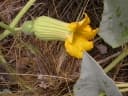
Cultivation Details
Cucurbita foetidissima is native to N. America, being found as far north as Nebraska and Iowa where it can experience winter temperatures as low as -20 to -25°c. It grows best in areas where annual daytime temperatures are within the range 20 - 30°c, but can tolerate 5 - 35°c[3]. The stems are frost-sensitive, being killed by temperatures below 0°c - the roots, however, are much more cold tolerant, and can survive winter temperatures as low as -25°c[3]. The plant prefers a mean annual rainfall in the range 400 - 600mm, but tolerates 250 - 1,000mm[3]. Requires a rich, well-drained moisture retentive soil and a very warm, sunny and sheltered position[4, 5]. Prefers a pH in the range 6 - 7, tolerating 5.5 - 8.5[3]. Established plants are very drought tolerant[6, 7]. Plants can be very vigorous. A four year old plant had a main taproot more than 2.5 metres long and 30cm in diameter at the crown, with a fresh weight of 45 kilos[7]. Cultivated plants in their third fruiting season have been known to produce over 300 primary stems and more than 200 mature fruits[7]. The optimum yield of seed is 2.5 tonnes/ha[3]. Plants can live for forty years or more[3]. This species does not hybridize naturally with other members of this genus though crosses have been made under controlled conditions[8].
Propagation
Seed - sow early to mid spring in a greenhouse in a rich soil. Germination should take place within 2 weeks. Sow 2 or 3 seeds per pot and thin out to the best plant. Grow them on fast and plant out after the last expected frosts, giving them cloche or frame protection for at least their first few weeks if you are trying them outdoors. Layering. Plants naturally and quickly form adventitious roots at the leaf nodes if they are in contact with moist soil. These can be used to produce new plants[7]. Cite as: Temperate Plants Database, Ken Fern. temperate.theferns.info. 2026-02-21. <temperate.theferns.info/plant/Cucurbita+foetidissima>
Pollinators
Bees, Insects
References
- [1]A Colour Atlas of Poisonous Plants. — Frohne. D. and Pfänder. J. · Wolfe · 1984 · ISBN 0723408394 ↩︎Brilliant. Goes into technical details but in a very readable way. The best work on the subject that I've come across so far.
- [2]The History and Folklore of North American Wild Flowers. — Coffey. T. · Facts on File. · 1993 · ISBN 0-8160-2624-6 ↩︎A nice read, lots of information on plant uses.
- [3]Ecocrop — http://ecocrop.fao.org/ecocrop/srv/en/home ↩︎Basic information on a wide range of useful plants, plus details of environmental needs where available.
- [4]RHS Dictionary of Plants plus Supplement. 1956 — F. Chittendon. · Oxford University Press · 1951 · ISBN - ↩︎Comprehensive listing of species and how to grow them. Somewhat outdated, it has been replaced in 1992 by a new dictionary (see [ 200 ]).
- [5]The New RHS Dictionary of Gardening. 1992. — Huxley. A. · MacMillan Press · 1992 · ISBN 0-333-47494-5 ↩︎Excellent and very comprehensive, though it contains a number of silly mistakes. Readable yet also very detailed.
- [6]The Book of Edible Nuts. — Rosengarten. jnr. F. · Walker & Co. · 1984 · ISBN 0802707699 ↩︎A very readable and comprehensive guide. Well illustrated.
- [7]The Feral Buffalo Gourd, Cucurbita foetidissima — Bemis W.P., Curtis L.D., Weber C.W. & Berry J. · 1978 ↩︎
- [8]Gourds. — Organ. J. · Faber · 1963 · ISBN - ↩︎Deals with squashes and their relatives. Interesting and readable, it gives cultivation techniques and some details of plant uses.
- [9]Flora of N. America — http://flora.huh.harvard.edu/fna/ ↩︎An on-line version of the flora with an excellent description of the plant including a brief mention of plant uses.
- [10]Tanaka's Cyclopedia of Edible Plants of the World. — Tanaka. T. & Nakao S. · Keigaku Publishing; Tokyo · 1976 · ISBN - ↩︎The most comprehensive list of edible plants I've come across. Only the briefest entry for each species, though, and some of the entries are more than a little dubious. Not for the casual reader.
- [11]Food Plants of the N. American Indians. — Yanovsky. E. · U.S. Depf of Agriculture. · ISBN - ↩︎A comprehensive but very terse guide. Not for the casual reader.
- [12]Cornucopia - A Source Book of Edible Plants. — Facciola. S. · Kampong Publications · 1990 · ISBN 0-9628087-0-9 ↩︎Excellent. Contains a very wide range of conventional and unconventional food plants (including tropical) and where they can be obtained (mainly N. American nurseries but also research institutes and a lot of other nurseries from around the world.
- [13]Earth Medicine, Earth Food. — Weiner. M. A. · Ballantine Books · 1980 · ISBN 0-449-90589-6 ↩︎A nice book to read though it is difficult to look up individual plants since the book is divided into separate sections dealing with the different medicinal uses plus a section on edible plants. Common names are used instead of botanical.
- [14]Dictionary of Economic Plants. — Uphof. J. C. Th. · Weinheim · 1959 · ISBN - ↩︎An excellent and very comprehensive guide but it only gives very short descriptions of the uses without any details of how to utilize the plants. Not for the casual reader.
- [15]A Dictionary of Plants Used by Man. — Usher. G. · Constable · 1974 · ISBN 0094579202 ↩︎Forget the sexist title, this is one of the best books on the subject. Lists a very extensive range of useful plants from around the world with very brief details of the uses. Not for the casual reader.
- [16]Early Uses of Californian Plants. — Balls. E. K. · University of California Press · 1975 · ISBN 0-520-00072-2 ↩︎A nice readable book.
- [17]Common Edible and Useful Plants of the West. — Sweet. M. · Naturegraph Co. · 1962 · ISBN 0-911010-54-8 ↩︎Useful wild plants in Western N. America. A pocket guide.
- [18]Native American Ethnobotany — Moerman. D. · Timber Press. Oregon. · 1998 · ISBN 0-88192-453-9 ↩︎Very comprehensive but terse guide to the native uses of plants. Excellent bibliography, fully referenced to each plant, giving a pathway to further information. Not for the casual reader.
- [19]Encyclopaedia of Herbs and their Uses. — Bown. D. · Dorling Kindersley, London. · 1995 · ISBN 0-7513-020-31 ↩︎A very well presented and informative book on herbs from around the globe. Plenty in it for both the casual reader and the serious student. Just one main quibble is the silly way of having two separate entries for each plant.
- [20]Encyclopaedia of Medicinal Plants. — Chiej. R. · MacDonald · 1984 · ISBN 0-356-10541-5 ↩︎Covers plants growing in Europe. Also gives other interesting information on the plants. Good photographs.
- [21]The Garden. Volume 112. — RHS. · Royal Horticultural Society · 1987 · ISBN - ↩︎Snippets of information from the magazine of the RHS. In particular, there are articles on plants that are resistant to honey fungus, oriental vegetables, Cimicifuga spp, Passiflora species and Cucurbits.
- [22]Edible and Useful Wild Plants of the United States and Canada. — Saunders. C. F. · Dover Publications · 1976 · ISBN 0-486-23310-3 ↩︎Useful wild plants of America. A pocket guide.
- [23]A Weavers Garden — Buchanan. R. · McGraw-Hill Contemporary · 1987 · ISBN 0934026289 ↩︎Covers all aspects of growing your own clothes, from fibre plants to dyes.
- [24]Plants for Human Consumption. — Kunkel. G. · Koeltz Scientific Books · 1984 · ISBN 3874292169 ↩︎An excellent book for the dedicated. A comprehensive listing of Latin names with a brief list of edible parts.
- [PFAF]Plants for a Future — pfaf.org ↩︎