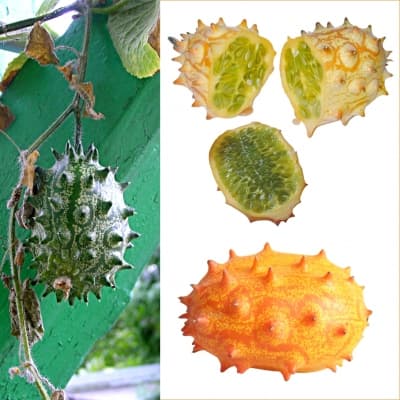
Cucumis metulifer
Cucumis metulifer
Safety & Hazards
The sprouting seed produces a toxic substance in its embryo[1]. Bitter-tasting fruits are often considered to be toxic by local people[2]. A significant proportion of wild-growing horned cucumber plants encountered in southern Africa are bitter-fruited and have caused poisoning. Bitter mature fruits may remain completely intact on the plants, as neither baboons nor other wildlife eat them. The amount of bitterness varies in immature and mature fruits on the same plant, with younger fruits having a less bitter taste. Bitterness is due primarily to the presence of cucurbitacins, bitter and toxic compounds occurring in Cucurbitaceae. Cucurbitacins can cause severe illness and death, due to their potent action as purgatives and laxatives[2].
Cultivation Details
The horned melon is a warm-season plant growing in tropical to subtropical and warm temperate regions, and does not tolerate cold conditions. It occurs at elevations from near sea level to 1,800 metres. A semi-arid climate with a warm-season rainfall regime appears to enhance the fruit ripening stage, allowing fruits to develop their full flavour[2]. Requires a rich, well-drained moisture retentive soil and a very warm, sunny sheltered position[3]. Plants tolerate a wide range of soil types throughout their natural distribution area[2]. Flowering starts about 8 weeks after sowing the seed, with male flowers appearing first, followed after several days by female flowers[2]. Under field conditions, time from sowing to harvest is around 15 weeks[2]. In New Zealand growers harvest up to 20 tonnes of fruit per hectare, in California about 8 tonnes whilst growers in Israel have harvested up to 46 tonnes[2]. Sweet-fruited plants reseed themselves with little management and protection in Zimbabwe. The fruits continue to be sweet, barring the occasional pollination by bitter-fruited wild plants[2]. Fruits of horned melon in southern Africa continue ripening after the cessation of the rainy season, long after the stems have died back[2]. There are some named varieties. This species does not hybridize with other members of the genus[2].
Propagation
Seed - sow early to mid spring in a greenhouse in a rich soil. Germination should take place within 2 weeks. Sow 2 or 3 seeds per pot and thin out to the best plant. Grow them on fast and plant out after the last expected frosts, giving them cloche or frame protection for at least their first few weeks if you are trying them outdoors. Cite as: Temperate Plants Database, Ken Fern. temperate.theferns.info. 2026-02-21. <temperate.theferns.info/plant/Cucumis+metulifer>
Pollinators
Insects
References
- [1]A Colour Atlas of Poisonous Plants. — Frohne. D. and Pfänder. J. · Wolfe · 1984 · ISBN 0723408394 ↩︎Brilliant. Goes into technical details but in a very readable way. The best work on the subject that I've come across so far.
- [2]Protabase - Plant Resources of Tropical Africa. — http://www.prota.org ↩︎An excellent on-line database with detailed information on over 3,200 species of useful plants of Africa.
- [3]The New RHS Dictionary of Gardening. 1992. — Huxley. A. · MacMillan Press · 1992 · ISBN 0-333-47494-5 ↩︎Excellent and very comprehensive, though it contains a number of silly mistakes. Readable yet also very detailed.
- [4]Mansfeld's Database of Agricultural and Horticultural Plants — http://mansfeld.ipk-gatersleben.de/pls/htmldb_pgrc/f?p=185:3:4292127278597336 ↩︎Terse details of a huge range of useful plants.
- [5]Flora Zambesiaca — http://apps.kew.org/efloras/fz/intro.html ↩︎An excellent online flora of plants from the Zambezi River basin. It lists a number of the plant uses as well as the habitats and botanical descriptions of the plants.
- [6]Sturtevant's Edible Plants of the World. — Hedrick. U. P. · Dover Publications · 1972 · ISBN 0-486-20459-6 ↩︎Lots of entries, quite a lot of information in most entries and references.
- [7]Dictionary of Economic Plants. — Uphof. J. C. Th. · Weinheim · 1959 · ISBN - ↩︎An excellent and very comprehensive guide but it only gives very short descriptions of the uses without any details of how to utilize the plants. Not for the casual reader.
- [8]A Dictionary of Plants Used by Man. — Usher. G. · Constable · 1974 · ISBN 0094579202 ↩︎Forget the sexist title, this is one of the best books on the subject. Lists a very extensive range of useful plants from around the world with very brief details of the uses. Not for the casual reader.
- [9]Tanaka's Cyclopedia of Edible Plants of the World. — Tanaka. T. & Nakao S. · Keigaku Publishing; Tokyo · 1976 · ISBN - ↩︎The most comprehensive list of edible plants I've come across. Only the briefest entry for each species, though, and some of the entries are more than a little dubious. Not for the casual reader.
- [10]Brazilian Fruits and Cultivated Exotics — Lorenzi. H.; Bacher. L.; Lacerda. M.; Sartori. S. · Instituto Plantarum De Estudos Da Flora LTDA; Brazil. · 2000 · ISBN 85-867174-24-0 ↩︎A superb book, giving information on several hundred fruit species. Each entry has a brief description of the plant and its uses, accompanied by one to many excellent quality photographs of the fruits.
- [11]Trade Winds Fruit — http://www.tradewindsfruit.com/index.htm ↩︎The on-line catalogue of a company selling seeds. Gives descriptions, photos and uses of a very wide range of fruit and other food-producing plants plus ornamentals.
- [12]Cornucopia - A Source Book of Edible Plants. — Facciola. S. · Kampong Publications · 1990 · ISBN 0-9628087-0-9 ↩︎Excellent. Contains a very wide range of conventional and unconventional food plants (including tropical) and where they can be obtained (mainly N. American nurseries but also research institutes and a lot of other nurseries from around the world.
- [13]Plants for Man. — Schery. R. W. ↩︎Fairly readable but not very comprehensive. Deals with plants from around the world.
- [14]Gourds. — Organ. J. · Faber · 1963 · ISBN - ↩︎Deals with squashes and their relatives. Interesting and readable, it gives cultivation techniques and some details of plant uses.
- [15]Plants for Human Consumption. — Kunkel. G. · Koeltz Scientific Books · 1984 · ISBN 3874292169 ↩︎An excellent book for the dedicated. A comprehensive listing of Latin names with a brief list of edible parts.
- [16]Encyclopaedia of Medicinal Plants. — Chiej. R. · MacDonald · 1984 · ISBN 0-356-10541-5 ↩︎Covers plants growing in Europe. Also gives other interesting information on the plants. Good photographs.
- [PFAF]Plants for a Future — pfaf.org ↩︎